The Feline Five: Every Cat Personality Type Explained
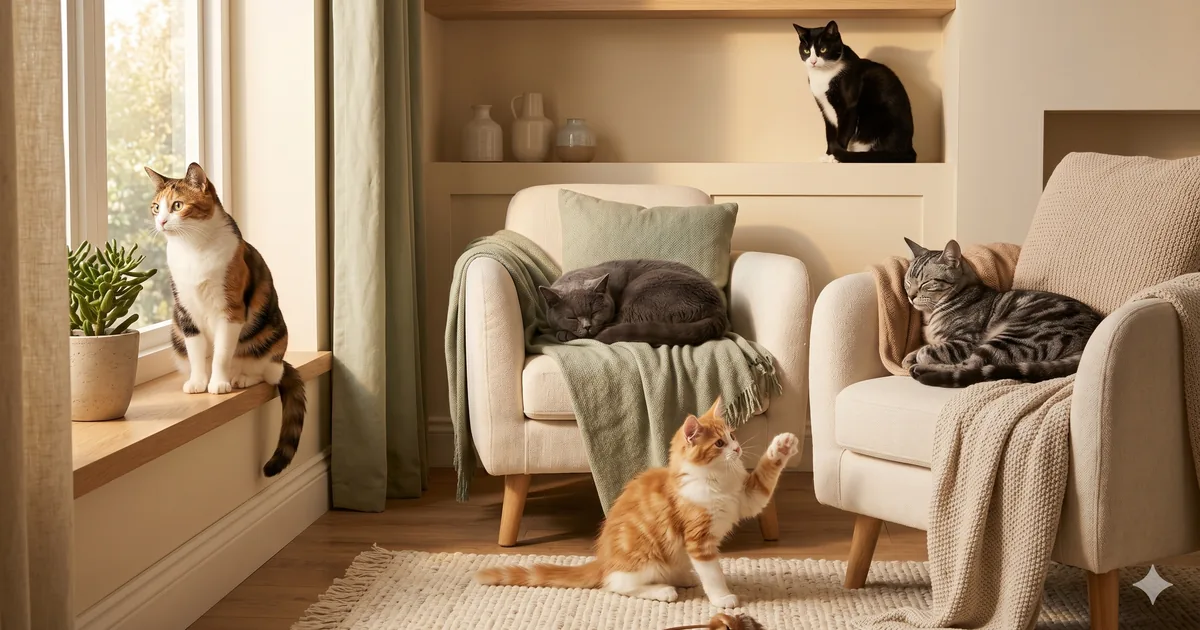
For decades, "cat personality" was treated as folk science. Every cat owner believed in it. No researcher quantified it. You got vague stereotypes — Siamese are vocal, Persians are aloof, ginger cats are wild — and that was the level of public discourse.
That changed in 2017. Litchfield et al. published "The 'Feline Five': An Examination of Personality in the Domestic Cat" in PLoS ONE. They surveyed over 2,800 cat owners across five countries, ran factor analysis on the responses, and identified five replicable personality traits in cats. Stable across adulthood. Independent of breed. Heritable.
It's the closest thing the cat world has to the Big Five (which is the canonical human personality framework). This is the science behind every cat-archetype meme that gets it right.
This guide is the practical walkthrough: the five traits, the nine archetypes most cats fall into, what each archetype tells you about how to live with your cat — and the 90-second test.
The five traits (research-validated)
Litchfield's framework names five replicable dimensions of cat personality. Every cat scores high, medium, or low on each:
1. Skittishness (anxious ↔ calm)
How easily a cat reacts to novel or surprising events. High-skittishness cats startle easily, hide longer after disruption, take more time to acclimate. Low-skittishness cats are emotionally stable and bounce back fast.
2. Outgoingness (sociable ↔ reserved)
How actively the cat seeks social interaction — with humans, other cats, visitors. High-outgoing cats greet strangers, follow owners room-to-room, lap-sit. Low-outgoing cats are independent, prefer solitude, form deep bonds with one or two specific humans.
3. Dominance (assertive ↔ submissive)
How much the cat asserts itself in resource conflicts. High-dominance cats guard food, claim sleeping spots, bully more submissive cats in multi-cat homes. Low-dominance cats yield resources and avoid confrontation.
4. Spontaneity (impulsive ↔ predictable)
How much the cat does abrupt, unpredictable things. High-spontaneity cats have sudden zoomies, surprise pounces, shifting moods. Low-spontaneity cats are routine-loving and behaviourally consistent across days.
5. Friendliness (affectionate ↔ aloof)
How affectionate the cat is once a relationship is established. High-friendliness cats seek physical contact, purr readily, tolerate handling. Low-friendliness cats may live happily alongside their humans without seeking touch.
The nine archetypes most cats fall into
Specific combinations of the five traits produce recognisable types. Most cats fit one of these loosely; a few don't fit any cleanly. Use these as a starting framework, not a rigid box.
The Velcro Cat
Extreme outgoingness + friendliness + attachment. Follows you to the bathroom. Lives on your lap. Common in Sphynx and many Oriental breeds.
The Confident-Sociable
High outgoingness, low skittishness. Meets every visitor at the door, treats the doorbell as a chance to make friends. Common in Maine Coons and Bengals.
The Curious-Introvert
Moderate outgoingness, low skittishness, low dominance. Confident at home, reserved with strangers. Common in Russian Blues.
The Anxious-Sensitive
High skittishness, low outgoingness, low dominance. Easily overwhelmed; takes weeks to settle into change. Often the result of inadequate kitten socialisation.
The Hunter-Athlete
High spontaneity, low skittishness, high outgoingness. Wand toys are non-negotiable. Common in Bengals, Abyssinians, Savannahs.
The Affectionate-Lap
High friendliness + outgoingness, low dominance. The storybook companion. Common in Ragdolls, Birmans, Scottish Folds.
The Skittish-Sensitive
High skittishness, low outgoingness, moderate friendliness with bonded humans only. Slow to trust; deeply bonded once trust forms. Common in some rescue cats.
The Cool Observer
Low outgoingness, low skittishness, low spontaneity. Watches everything, reacts to little. The cat-shaped equivalent of a long-time housemate. Common in British Shorthairs.
The Goofball
High spontaneity, high outgoingness, high friendliness, low dominance. The class clown. Plays fetch, knocks things off on purpose, gets into harmless mischief.
Why your cat's archetype changes how to live with her
Knowing the archetype reframes everything. A Skittish-Sensitive cat who hides under the bed when guests come isn't broken — she's being a Skittish-Sensitive cat correctly. The work is to build the environment that lets that personality thrive: hides, height, quiet, predictability.
An Affectionate-Lap cat left alone for 12-hour workdays isn't happy with her own company — she's suffering from a personality-environment mismatch. The fix is a companion cat, a midday visitor, or a job change.
A Hunter-Athlete in a small apartment with no daily play turns her energy into furniture destruction. The fix is wand toys and catification, not punishment.
Personality is descriptive, not normative. There's no "good" or "bad" cat personality. There are only environments that match or mismatch the personality you have.
The 90-second test
We built the first interactive Feline Five test at catmd.pet/cat-personality-test — 10 questions, scored against the five traits, matched to your cat's most-likely archetype. Free, no signup, takes about 90 seconds.
Try it. Compare the result against what you already know about your cat. The fit is usually startlingly precise — which is the experience that converts skeptics. Cat personality is real science, not astrology.
For the full research background, including the original Litchfield study and the trait-to-archetype mapping, see our deep-dive on the Feline Five framework and the science of cat personality.
The verdict: every cat has a personality. The framework lets you stop fighting your cat's nature and start designing around it.
Try CatMD
The cat AI this post is about. 14-day free trial with full Pro access. No card on file.
Get on Google Play