Cat Straining to Urinate: 48-Hour Vet Emergency
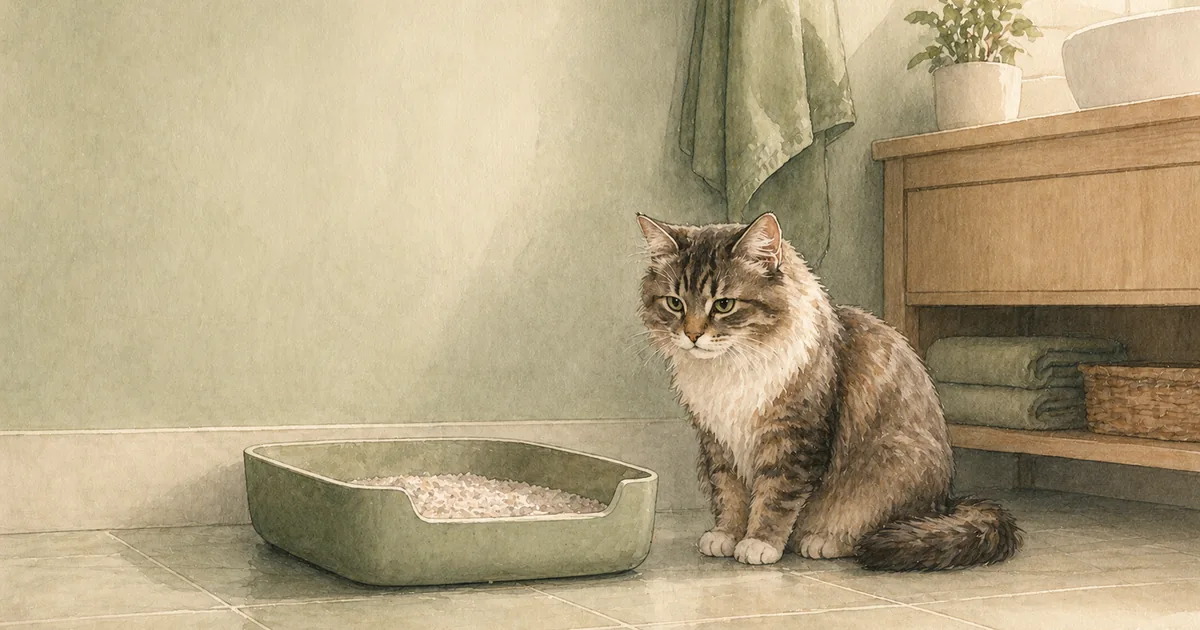
This is one of the most time-sensitive emergencies in small-animal medicine, and almost every cat parent misses it at first because the behavior looks like "constipation" or "maybe a UTI."
What you're actually seeing
A cat with a urethral blockage will typically:
- Make repeated trips to the litter box (sometimes every few minutes)
- Squat and strain, often vocalizing
- Produce little or no urine, or a few pink-tinged drops
- Have a hard, tender abdomen (don't press firmly — you can rupture the bladder)
- Become lethargic, hide, or refuse food as the hours pass
- Vomit as kidney values rise (late sign — do not wait for this)
- Progress to collapse within 24–48 hours
Female cats can also get partial obstructions, but anatomic differences make full blockage much less common.
Why 48 hours is the window
Urine is how the body eliminates potassium. When the bladder can't empty, potassium rises in the blood — hyperkalemia. At levels above 8–9 mEq/L, the heart starts to slow and eventually stops. This happens in roughly 24–48 hours from complete obstruction.
The math is brutal:
- Hours 0–12: cat looks uncomfortable but alive
- Hours 12–24: lethargy, vomiting, refusing food
- Hours 24–48: life-threatening metabolic crisis
- Beyond 48: cardiac arrest
The cat does not get better on their own. They will die.
How to tell obstruction from constipation
| Sign | Obstruction | Constipation |
|---|---|---|
| Straining location | Urinating | Defecating |
| Output | Little/no urine, maybe pink | Hard stool eventually, or none |
| Frequency | Many short trips | Fewer, longer efforts |
| Abdominal feel | Hard, very tender | Lumpy but not firm |
| Progression | Rapid decline | Slower |
| Breed/sex | Much more common in males | Any cat, more in seniors |
If you're not sure, treat it as obstruction. Missing a constipation diagnosis costs you a few extra hours at the vet; missing obstruction costs you your cat.
What causes urethral obstruction
- FLUTD — inflammation creating a plug of mucus, crystals, and cellular debris
- Crystalluria — calcium oxalate or struvite crystals
- Bladder stones that migrate into the urethra
- Urethral spasm secondary to feline idiopathic cystitis (FIC)
Male cats are far more vulnerable because their urethra narrows dramatically at the tip of the penis.
Risk factors
Your cat is at elevated risk if they:
- Are male (especially neutered)
- Are overweight
- Eat a primarily dry-food diet (low water intake)
- Are indoor-only and sedentary
- Live in a multi-cat household (stress triggers FIC)
- Have had a prior obstruction (recurrence is common)
- Are 2–7 years old (peak incidence age)
What to do, right now
- Call an emergency vet. Not a regular vet. You need someone who can sedate and catheterize tonight.
- Drive, don't wait. Every hour increases the risk.
- Do not give any medication. Not human painkillers, not leftover antibiotics. These can be fatal.
- Do not press the abdomen firmly. A full bladder can rupture.
- Bring a history. When the cat last urinated normally, diet, any recent stress event.
After the crisis — preventing a recurrence
- Switch to a wet-food or mixed diet (water content is protective)
- Prescription urinary diet if recommended (Royal Canin Urinary SO, Hill's c/d, Purina UR)
- Reduce stress — add cat trees, multiple litter boxes, Feliway diffusers
- Weight management if overweight
- Watch for early signs every time — small changes in litter habits matter
What the vet will do
Most blocked cats need sedation, pain control, bloodwork, electrolytes, IV fluids, and urinary catheter placement. The catheter relieves the obstruction, lets the bladder empty, and gives the kidneys time to recover. Many cats stay hospitalized for 24-72 hours because potassium, kidney values, urine output, and pain have to be watched closely.
If potassium is high, the team may treat the heart risk first before anesthesia. If the bladder has been stretched for too long, it may not contract normally right away. That is why a cat who seems "unblocked" for a few minutes at home still needs a hospital, not observation.
How CatMD helps after discharge
The dangerous part after a first blockage is recurrence. Owners are usually sent home with diet changes, pain medication, antispasmodics, and instructions to watch the litter box. CatMD can make that watch concrete: record clump size, frequency, straining, hiding, appetite, water intake, and stress events in one timeline.
Bring that timeline to the recheck. A note like "three tiny clumps and two straining attempts since midnight" is more actionable than "he seems off." For a recurrent blocker, minutes matter, and the pattern is often visible before the crisis is dramatic.
Triage your cat in under 60 seconds
Not sure if this is an emergency? CatMD runs feline-specific triage on symptoms or photos and returns a 0–99 health score with urgency tier, differentials, and a vet-ready summary.
Get the app