How to Prepare for a Cat Vet Visit (and Get the Diagnosis Faster)
Most vet visits get the right diagnosis. But many of them take longer than they need to, surface less detail than they could, and result in higher bills than necessary — because the owner walked in unprepared and the vet had to spend half the appointment extracting information by question. The fix is structured preparation, and it's mostly about logging things in advance.
This piece is the prep checklist for any non-emergency vet visit. For emergencies, skip the prep and go — the emergency vet works with whatever they have. For everything else, 15 minutes of structured prep makes the visit dramatically more productive.
The 6-item bring list
1. Structured symptom timeline
Date, time, and description of each symptom. Not "she's been off for a few days" — instead: "Tuesday morning ate normally, Tuesday evening skipped dinner, Wednesday morning hiding under the bed for first time in months, ate 30% of breakfast, vomited once at noon, gum colour pale at 6 PM."
Pattern + chronology is what vets need to triage. The verbal "she's been off" is the right intuition but the wrong format.
2. Eating + drinking log (last 7-14 days)
Meal-by-meal where possible. What food, how much eaten, time, water intake if measurable. Cats hide reduced appetite well; the log is more reliable than memory. If you're tracking via a cat-care app with a daily check-in, this is automatic; otherwise a notebook works.
3. Litter box log
Number of urinations and bowel movements per day. Stool quality (normal, soft, hard, diarrhoea, blood). Any unusual content (mucus, hair, foreign material). Any straining. For multi-cat households where you can't attribute outputs cleanly, note that — the vet will adjust their workup accordingly.
4. Photos and video of visible symptoms
If your cat has been throwing up — photograph or describe the vomit (colour, content, foam, blood). If there's a skin issue — photograph it daily over the past week to show progression. If gait is affected — short video of the cat walking. Vets often see things in photos taken at home that aren't reproducible in the exam room.
Yes, this includes photos of stool. Yes, vets are happy to look at them. The "is it the right colour and shape" question is much easier answered by a photo than by description.
5. Current medications + supplements
Names and doses of every medication, supplement, flea treatment, and prescription diet. If you don't remember exact doses, bring the bottles. This includes things you might not think of as "medication" — joint supplements, fish oil, calming chews, food toppers. Anything ingested counts.
6. Recent changes (last 14 days)
Diet changes — new food, new brand, even a flavour switch. Household changes — new humans, new pets, departed humans, departed pets, visiting guests, contractors in the house. Environmental changes — moved furniture, new cleaning products, new plants, opened windows after winter. Schedule changes — different work hours, vacation, kids on school break. Anything different.
Cats are extremely sensitive to environmental change. Stress-driven physical symptoms are common. The vet needs to know what changed.
The vet-ready PDF (the modern version of all six items)
Modern cat-care apps generate a structured 12-month or 6-month report that bundles all of the above plus weight trend, scan history, vaccination status, and check-in patterns into a single PDF. One tap → email to the vet ahead of the visit OR show on phone in the exam room. The vet reads 12 months of structured context in 60 seconds rather than extracting it via Q&A.
If you're using a cat-care app with this feature, generate the PDF the morning of the visit. If you're not, the manual checklist above is the substitute. Either way, the principle is the same — the vet's time goes further when the data arrives organised.
Carrier preparation — the part most owners skip
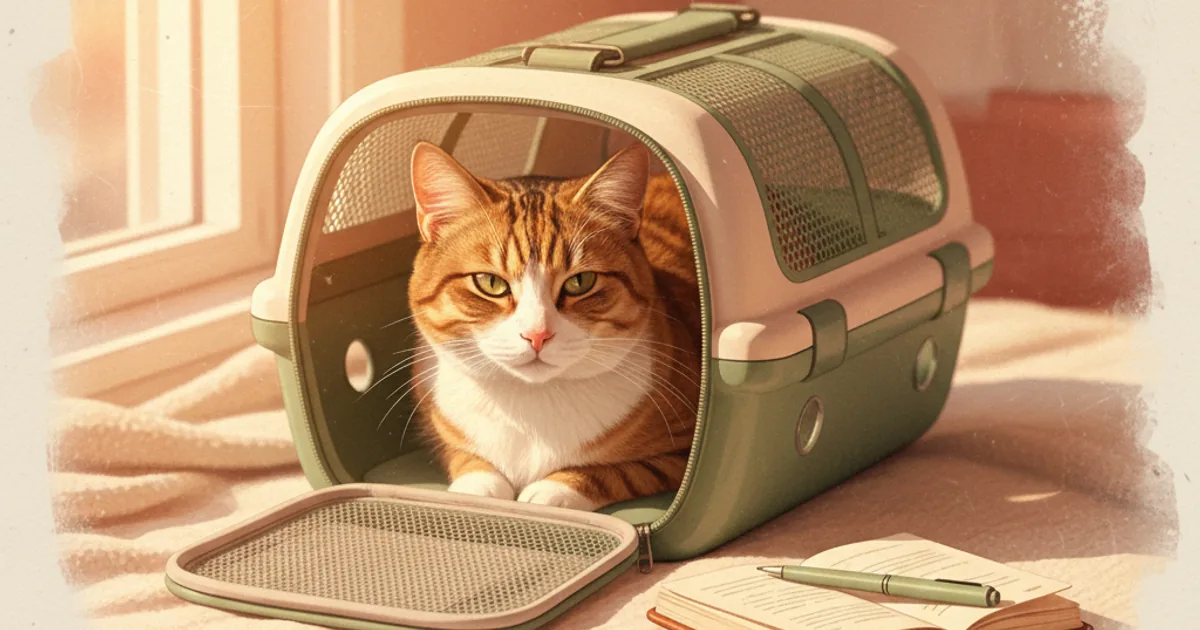
Carrier-related stress dominates most cats' vet experiences. The carrier appears, the cat hides, the wrestling begins, the carrier becomes an exclusive predictor of needles. Half of "vet stress" is "carrier stress."
The fix is carrier conditioning, and it works:
- Leave the carrier OUT as a normal piece of furniture year-round. Not stored in a closet appearing only on vet day.
- Treat-pair — put a treat inside the carrier daily for weeks. The cat learns the carrier predicts good things.
- Feed meals near or in the carrier — strongest positive association possible.
- Take short non-vet car rides — 5 minutes around the block, treat at the end. Breaks the "carrier = vet" exclusive association.
- Spray Feliway (synthetic feline facial pheromone) inside the carrier 15 minutes before any trip. Reduces stress significantly for many cats.
- Bring a soft towel from home — familiar scent reduces stress in the exam room.
- Cover the carrier with a light cloth in the waiting room — visual barriers reduce dog-related and unfamiliar-cat stress.
If the carrier is a wrestling match every visit, the cat's stress hormones (cortisol, catecholamines) spike before the exam even starts — affecting heart rate, blood pressure, and behaviour. Calmer cat, more accurate exam, better-tolerated procedures.
Choose the right carrier
If you're buying a new carrier:
- Hard-sided with top opening AND front opening — vets prefer this style because they can examine the cat from the top half-shell without having to extract the cat through a small front door.
- Disassembling top half — many modern carriers come apart so the cat can stay in the bottom half during the exam, hugely reducing stress.
- Sized appropriately — large enough for the cat to stand and turn around, not so large that the cat slides around in transit.
If you're buying for the long term, an open-top carrier from a vet-recommended brand is worth the modest extra cost.
The day-of timing
- Day before: generate the vet-ready PDF or compile the checklist above. Spray Feliway in the carrier overnight if the cat will allow it being out.
- 2 hours before: normal feeding (unless vet specified fasting). Spray Feliway again if not done overnight.
- 30 minutes before: get the cat into the carrier. Don't chase — bring the carrier to where the cat is, drop a high-value treat in.
- 15 minutes before: drive over. Cover the carrier with a light cloth.
- In the waiting room: keep the carrier off the floor (chair is fine). Talk to the cat in a quiet calm voice. Don't sit next to a barking dog if you can avoid it.
- In the exam room: let the cat come out on their own terms when possible. Hand the vet your PDF or notes immediately. Ask what they're doing as they go.
The questions to ask in the exam room
Three categories of question that reliably make the visit more useful.
Diagnostic
- "What's the differential right now?" (what conditions are you considering)
- "What would change your assessment?" (which test results or observations move the diagnosis)
- "What's the worst case scenario, and how would we know if it's that?"
Treatment
- "What are the treatment options?" (often more than one — useful to know the tradeoffs)
- "What would you do if this were your cat?" (vets are usually willing to share their personal call)
- "What's the expected timeline for improvement / next decision point?"
Home monitoring
- "What should I watch for at home?"
- "What would warrant calling you back vs going to ER?"
- "When should we recheck?"
What this changes day-to-day
For a healthy cat at routine wellness visits: the prep is light — bring the latest weight, mention any minor observations, ask what to do next. For a cat with active concerns: the structured timeline + meal log + photos + medication list change a 30-minute "extract the history by Q&A" visit into a 15-minute "look at the data, do the exam, plan next steps" visit. Better diagnosis, lower bill, less stress on the cat.
Pair the prep with carrier conditioning that's been ongoing for weeks, and the cat's vet experience is fundamentally different — calmer, more accurate, more sustainable for years of routine senior care.
Frequently asked questions
What should I bring to my cat's vet visit?
Six things. (1) STRUCTURED TIMELINE of symptoms — date, time, and description of each. (2) EATING + DRINKING LOG for the last 7-14 days, meal-by-meal if possible. (3) LITTER BOX LOG — frequency, stool quality, any abnormal content. (4) PHOTOS OR VIDEO of any visible symptom (eye discharge, posture, gait, vomit, abnormal stool). (5) CURRENT MEDICATIONS + SUPPLEMENTS with names and doses (bring the bottles if you don't remember exactly). (6) RECENT CHANGES in diet, household, new pets, new humans, moved furniture, anything different in the last 14 days. The structured observations turn "she's been off" into "Tuesday morning she ate normally, Tuesday evening she skipped dinner..." — which dramatically shortens the diagnostic conversation.
How do I make the carrier less traumatic?
Carrier conditioning takes weeks of low-stakes practice and pays off for life. The technique: leave the carrier OUT as a normal piece of furniture (not stored in the closet appearing only on vet day). Treat-pair the carrier — put a treat inside daily for weeks. Feed meals near or in the carrier. Take the cat on short non-vet drives so the carrier doesn't exclusively predict needles. For the actual vet day, spray Feliway (synthetic feline pheromone) inside the carrier 15 minutes before. Bring a soft towel that smells like home. Cover the carrier with a light cloth in the waiting room — visual barriers reduce stress significantly.
What's a "vet-ready PDF" and why does it help?
A structured 12-month or 6-month report that summarises weight trend, scans, check-ins, vaccinations, medications, and symptoms in vet-readable format. Modern cat-care apps generate these in one tap. The vet can read 12 months of context in 60 seconds — much faster than extracting it from a verbal "she's been off for a while" conversation. Bring it on your phone, email it ahead of the visit, or print it. The vet's exam time goes much further when they walk in with the timeline already in their head.
Should I withhold food before the visit?
Only if the vet specifically asks (usually for blood draws where fasting changes results, or before sedation). For routine visits, normal feeding is fine. Calling ahead to ask is the cleanest answer; vet receptionists handle this question often and can tell you. If your cat is a "won't eat in the carrier" type, withholding the morning meal so they'll accept high-value treats (chicken, churu) at the vet for blood-draw distraction is sometimes useful — but check first.
How can I help the actual exam go better?
Three small things matter. (1) Bring the cat in a carrier they can be examined from — open-top carriers or carriers that disassemble into a half-shell let the vet examine the cat without having to dump them out, which is much less stressful. (2) Speak in a quiet calm voice during the exam — your tone changes the cat's stress level, which changes their behaviour, which changes what the vet can examine. (3) Ask the vet what they're doing as they do it — "what are you palpating now?", "what does the gum colour look like?" — this turns the exam into a learning experience and helps you understand the differential better.
Triage your cat in under 60 seconds
Not sure if this is an emergency? CatMD runs feline-specific triage on symptoms or photos and returns a 0–99 health score with urgency tier, differentials, and a vet-ready summary.
Get the app