Can AI Actually Translate What Your Cat Is Saying?
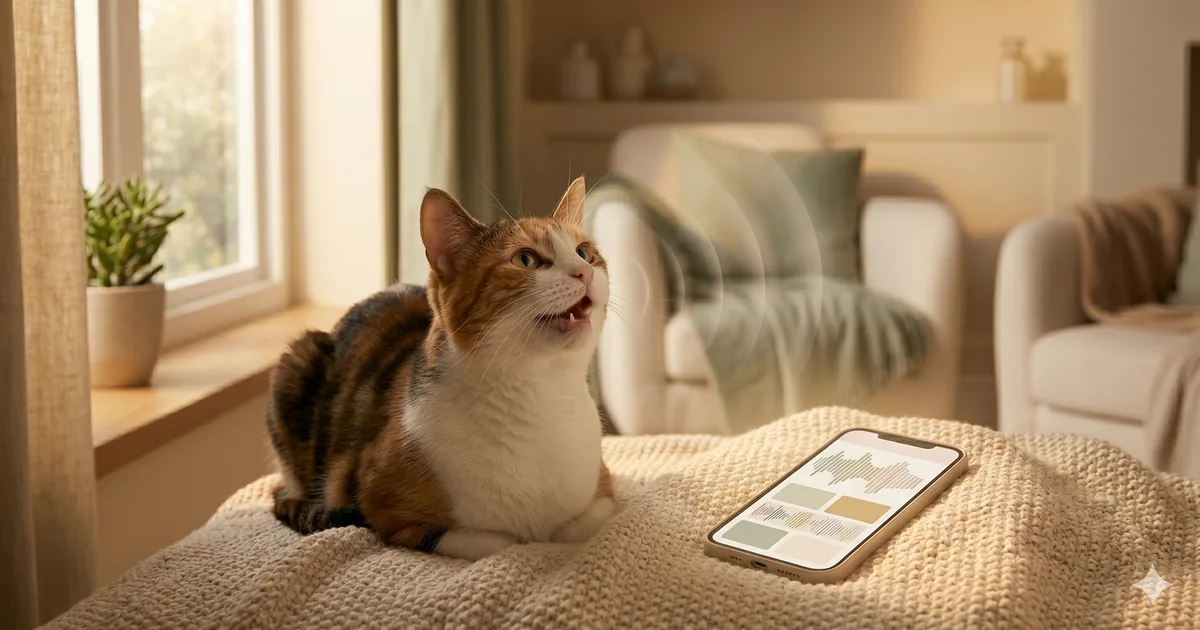
The short answer is no. AI cannot translate what your cat is saying. Not in the sense of "she meowed twice and the app told me she wants tuna." That's not a thing that's possible — not because the AI isn't smart enough, but because cats don't have a language to translate.
The longer answer is more interesting. What AI can do — what the better cat apps are actually doing — is interpret signals across multiple channels. That's a real, useful, somewhat-magical thing. It's just not translation. This post is about the difference, and why the difference matters.
Why "translation" is the wrong word
A translation system maps tokens in language A to tokens in language B. "Bonjour" → "Hello." That mapping works because both source and target are structured languages with finite vocabularies and consistent meaning per token.
Cat meows don't have that structure. A 2024 review of cat vocalisation research found:
- Cats produce 21+ distinct sound types in the lab, but use about 8 in everyday life
- The same meow can mean wildly different things from the same cat depending on context (food, attention, threat, mating, illness, simple greeting)
- Crucially: cat vocalisations are not shared across individuals. Every cat develops her own vocabulary with her human. Lily's "I want tuna" meow does not generalise to your cat's "I want tuna" meow. There's no inter-cat consistency in the audio signal.
This last point is the killer. A "meow translator" trained on 10,000 cats and 10,000 owner-reported intents would, at best, output a probabilistic guess: "this meow is in the 'request' bucket with 73% confidence." That's not translation. That's audio classification, and it's a much weaker claim than the marketing usually implies.
See our deep-dive on how meow translators actually work for the technical detail on what audio-only classification can and can't tell you.
What the better apps are doing instead
The interesting work isn't audio translation. It's multimodal interpretation: combining audio with other signals to produce a more grounded read of what the cat is communicating in this moment.
The channels available are:
- Audio — meow, chirp, purr, growl, hiss, trill. Pitch, duration, intensity.
- Body language — tail position, ear orientation, eye state, posture, motion patterns.
- Context — time of day, recent events, what's happening in the environment.
- Per-cat memory — what this specific cat has done in the past in similar moments.
- Personality — the cat's archetype (per the Feline Five framework) shapes what behaviours mean for THIS cat.
- Health state — recent check-ins, mood, appetite, pain-face score — all of which colour interpretation.
A cat sitting at the food bowl, meowing, with ears forward and tail up at 6:45 PM — that's an unambiguous "feed me" combining audio + body language + context. No interpretation needed.
A cat sitting in the middle of the room, meowing, with ears slightly back, tail twitching, at 3 AM — that's something else entirely. Could be discomfort, anxiety, a request to go somewhere, or (in older cats) a sign of feline cognitive dysfunction. The audio alone doesn't tell you. The combination of audio + body + context + age + recent diary entries narrows it sharply.
That's the actual work. Not translation. Interpretation across channels.
What CatMD's Meow Translator actually does
We built CatMD's Meow Translator as a multimodal interpreter, not a literal translator. When you record a meow:
- The audio is classified into intent buckets (request, complaint, greeting, in-heat, mating, etc.).
- Recent context is layered: how today's mood was logged, whether the cat just ate, whether a vet visit happened recently, who's in the household photo gallery.
- The cat's personality (from the Feline Five quiz) and accumulated memory adjust the read. A Velcro Cat's meow has different probability weights than a Cool Observer's.
- The output is a first-person interpreted line in the cat's voice — not a label. Something like: "I would like the chair. You are in the chair." rather than "intent: request displacement."
It's not magic. It's not literal translation. It's an honest, multi-signal, personality-aware guess at what the cat is most likely communicating in this moment. Sometimes it's funny. Sometimes it's startlingly accurate. Sometimes it's wrong — and we say so, because that's the honest framing.
The comparison with MeowTalk, CatGPT, and others
For the field comparison — what each AI cat translator app actually does, what each is good at, where each one falls short — see our objective comparison of AI cat health apps.
The short version: MeowTalk has the brand and the audio-classification depth. CatGPT-style apps lean on chat with the cat as a creative interface. CatMD pulls multiple signals together. None of them literally translate. The category as a whole is "interpretive companion," not "linguistic translator."
Why this matters
The "translation" framing is misleading marketing, and it lowers user trust over time. Users open the app expecting an oracle, get a categorical label, and feel duped. The honest framing — "we interpret signals across multiple channels to give you a plausible read of what your cat might be communicating" — is less sexy in a press release. It's also more useful, more accurate, and more durable.
If you want literal cat-to-English translation, no app can do it. If you want a tool that helps you understand your cat better — by reading more channels than you can hold in your head at once, and giving you a per-moment, per-cat, per-personality interpretation — that's what the better cat AI apps actually do.
Try CatMD's Meow Translator + Body Language Reader to see the difference. Free on Google Play.
The verdict: AI can't translate cats. But it can read them, in ways your eye alone can't. That's the actual product.
Try CatMD
The cat AI this post is about. 14-day free trial with full Pro access. No card on file.
Get on Google Play