AI Cat Translator: How Meow Translation Apps Work
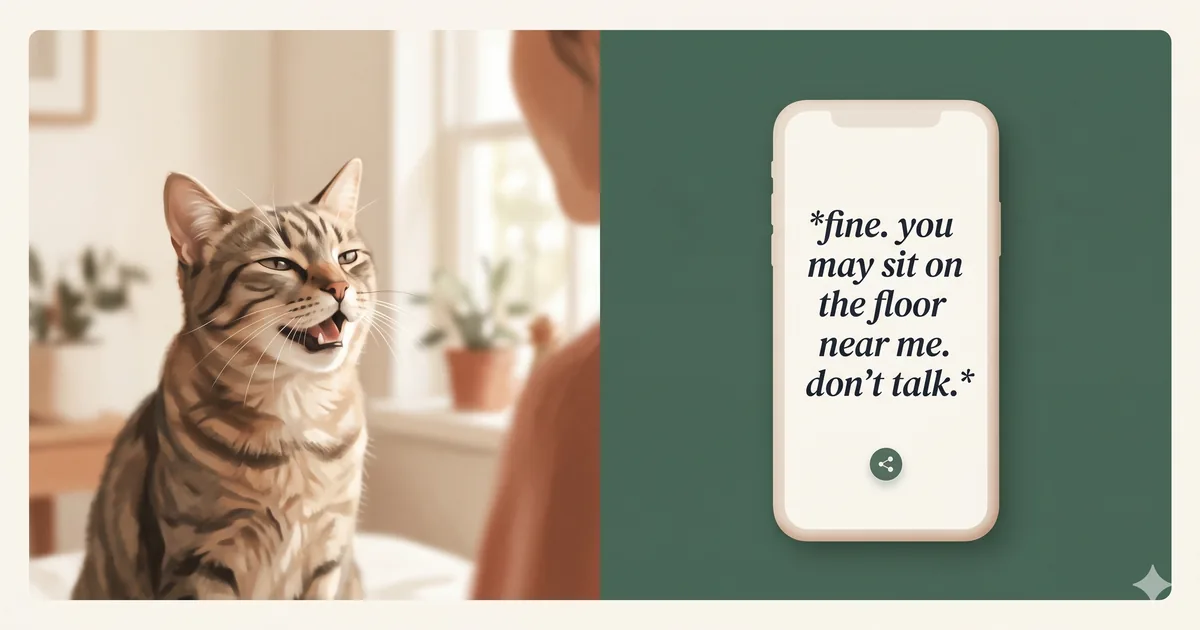
Cat translator apps have been on the App Store for over a decade. Most of them work the same way — record a meow, run it through an audio classifier, return one of about a dozen fixed labels. "Happy/Content." "Hunting." "Resting." Useful as a novelty for a week, then they stop being interesting. The label is the same for every cat in every household, and there is nothing to share with a friend.
(For the skeptical-honest take on whether AI can actually translate a cat at all, see our blog: Can AI Actually Translate What Your Cat Is Saying?)
A new generation of multimodal meow interpreters works differently — they capture short video instead of audio alone, fuse the meow with body language and per-cat memory, and return one interpretive line in the cat's specific voice. This piece explains how that pipeline works under the hood, why the output is qualitatively different, and what the underlying research actually says.
The audio-only generation — what it does, where it stops
The classic cat-translator app does one thing well: it records a meow, transforms the waveform into a spectrogram, and runs a classifier that maps the spectrogram to one of roughly ten to thirteen vocalisation categories. The classifier is usually trained on a published dataset of labelled cat vocalisations.
Two of the most-cited research datasets are the CatSound dataset (Pandeya et al, MDPI Applied Sciences, 2018) — a ten-class set of around 3,000 cat-sound samples covering states like resting, hunting, mating, defending, and paining — and CatMeows (Ludovico et al, 2020), which contains 440 vocalisations from 21 cats across three controlled contexts: brushing, isolation in an unfamiliar environment, and waiting for food. Audio-only classifiers built on these and related corpora can distinguish vocalisation context with accuracy in the 80-95% range on their own test splits.
The datasets and the classifiers are real and useful. The limitation is structural: the output of an audio-only classifier is a CATEGORY, not a SENTENCE. The model can tell you the meow falls in the "isolated" cluster or the "waiting for food" cluster — it cannot tell you what your cat would plausibly be saying about that situation, because it has no information about your cat as an individual.
This is why audio-only interpreters plateau. The category is the same on day one as on day three hundred. There is nothing to compound.
The multimodal generation — three inputs, one output
A modern multimodal meow interpreter captures four seconds of video instead of audio alone. That single change unlocks two additional input channels.
Channel 1 — Audio
Same as before: the meow is transcribed (often via Whisper or a similar speech-to-text model running over the vocalisation) and classified into one of the ten or so vocalisation types — meow, trill, chirp, purr, hiss, growl, yowl, chatter, silent (no audio, body-only read), other. The intent gets a similar classification: greeting, demand for food, demand for attention, annoyed, playful, comfort-seeking, warning, distress, curious, self-soothing.
This is the same engineering audio-only interpreters have always done. It is necessary, not sufficient.
Channel 2 — Body language
The four-second video lets the model see what the cat is doing across time, not just what the cat sounds like at one moment. Posture, ear position, tail movement, pupil dilation, motion patterns. The body-language signal carries roughly half of cat communication on its own — see the existing guide on reading ears, whiskers, eyes, and posture and the companion piece on tail language for the full inventory.
Pairing audio with body language resolves ambiguities the audio cannot resolve alone. The same yowl can be a territorial warning, a mating call, or pain depending on what the cat's body is doing while it yowls. A meow with a tail-up greeting posture means something different from the same meow with a defensive crouch and dilated pupils. The body-language channel is what makes the interpretation contextual instead of categorical.
Channel 3 — Per-cat memory
This is the channel audio-only interpreters do not have at all. A modern multimodal app maintains a structured memory of the specific cat — name, breed, personality archetype, recent diary entries, recent triage flags, what the cat ate yesterday, who the named family members in the household are, whether there has been a recent vet visit.
The personality archetype matters most. Different cats with the same physical signal would say different things, in different registers. A worked example — same posture, same meow, two cats:
A Velcro-Cat would say: "i missed you. the chair held the shape of you. lap."
A Cool-Observer in the same physical state would say: "yes. i hear the thing. it is beneath my dignity to react."
The audio is identical. The body language is identical. The per-cat memory layer is what produces two completely different interpreted lines. This is why modern interpreters feel personal in a way audio-only ones never did — because they are. The five-archetype framework most multimodal apps draw on is the Feline Five (Litchfield et al, PLOS ONE, 2017), a peer-reviewed personality model developed from a survey of more than 2,800 cats living in homes.
What "fuse the three channels into one line" actually means
The fusion step is where multimodal AI does its work. The audio classification, the body-language read, and the per-cat memory all become inputs to a large language model — typically a multimodal model in the GPT-4o or Gemini family — with a prompt that asks: given this audio, this body language, and this cat's profile, what is one short line this specific cat would plausibly be saying right now, in their voice.
The model returns a single sentence, typically 40 to 160 characters, in the first person, ending with a period. Honest apps add hard rules to the prompt to prevent generic outputs — if the line could plausibly be applied to any cat, it gets regenerated. The output is calibrated for one thing: the screenshot. A short, specific, in-voice line that the owner will send to a friend and that the friend will instantly recognise as belonging to that specific cat.
Why the output gets sharper over time
The per-cat memory layer compounds. Every interaction the cat has with the app — every diary entry, every photo tagged with named people, every triage scan, every previous translation — becomes context for the next translation. After a few weeks of use, a multimodal interpreter knows things about your cat that no audio-only system can ever access: the name of the human the cat sleeps near, the brand of food the cat refused last week, the eye that was inflamed three weeks ago.
Those facts get woven into the interpreted lines when they are relevant. A meow in a posture that suggests discomfort, in a cat with a recent eye-triage flag, might come back as "i am purring but i am not okay. eye still hurts. stay close." instead of a generic discomfort label. The line is interpretation, not diagnosis — but it is interpretation that points the owner toward a specific thing to watch.
What modern interpreters do not claim
The honest framing matters. Multimodal interpreters do not decode cat language — cats do not have a structured language with a one-to-one mapping between sounds and meanings. They interpret, in the same sense a thoughtful cat-savvy friend interprets when reading your cat across the room. The output is plausible inner-monologue, anchored on real signals (audio, body language, history), but it is not a transcription.
The other thing they do not claim is clinical diagnosis. When the body-language read or the audio classifier flags distress, a well-designed app routes the owner toward symptom triage rather than producing a screenshot-worthy line. The flag is a behavioural observation worth investigating. The diagnosis is the vet's call.
What this changes day-to-day
For owners who used audio-only interpreters years ago and abandoned them after the novelty wore off, the relevant update is: the underlying technology has changed enough that the experience is different. The label is gone, replaced by a line. The line is in your specific cat's voice instead of in a generic register. The output gets more specific the longer you use the app, because the per-cat memory compounds.
None of this replaces the fundamental cat-reading skills. The vocalisation vocabulary covered in the existing piece on how to read your cat's sounds is still the foundational literacy, and the body-language guide is still the day-to-day reference. A multimodal interpreter is not a substitute for learning to read your own cat. It is a way to compress moments your cat is already showing you into something you can save and share.
Two cats in the same household with two different archetypes will, over time, develop two distinct voices in a multimodal interpreter that audio-only systems would have given identical labels. That is the difference, and it is the reason the second generation of these apps is worth a fresh look.
Frequently asked questions
Do meow translator apps actually work?
Audio-only translators classify meows into fixed labels like "Happy/Content" or "Hunting," which are generic across all cats. Modern multimodal translators add body language and per-cat memory, producing personalized interpretations of what your specific cat might be saying rather than categorical outputs.
Is the AI actually translating, or guessing?
These systems interpret rather than translate. Cats lack structured language with one-to-one sound-meaning mappings. Apps analyze audio, body signals (ear position, tail movement, pupil dilation, posture), and cat-specific knowledge to generate plausible inner-monologue lines — similar to how a knowledgeable cat person would read a cat.
Why does the same meow give different translations for different cats?
Audio represents only one of three inputs in multimodal systems. Body language and per-cat memory vary by cat. A Velcro-Cat and a Cool-Observer producing identical sounds and postures receive different interpreted lines based on their personality archetypes.
What about distress sounds — can these apps flag emergencies?
Better translators classify distress intent when audio and body language indicate pain, fear, or acute stress, directing owners toward symptom triage rather than screenshot-worthy outputs. Distress flags represent behavioral observations, not clinical diagnoses — veterinary examination determines cause.
How accurate is the vocalisation classification underneath?
Research datasets like CatMeows (Ludovico et al, 2020 — 440 vocalisations from 21 cats) and the CatSound dataset (Pandeya et al, MDPI Applied Sciences 2018) demonstrate machine classifiers can distinguish core vocalization types — meow, trill, chirp, purr, hiss, growl, yowl, chatter — with accuracy comparable to human listeners on isolated clips. Intent classification improves significantly when body-language and memory context are added — context audio-only systems cannot access.
Triage your cat in under 60 seconds
Not sure if this is an emergency? CatMD runs feline-specific triage on symptoms or photos and returns a 0–99 health score with urgency tier, differentials, and a vet-ready summary.
Get the app