Cat Body Language: Ears, Eyes, Tail
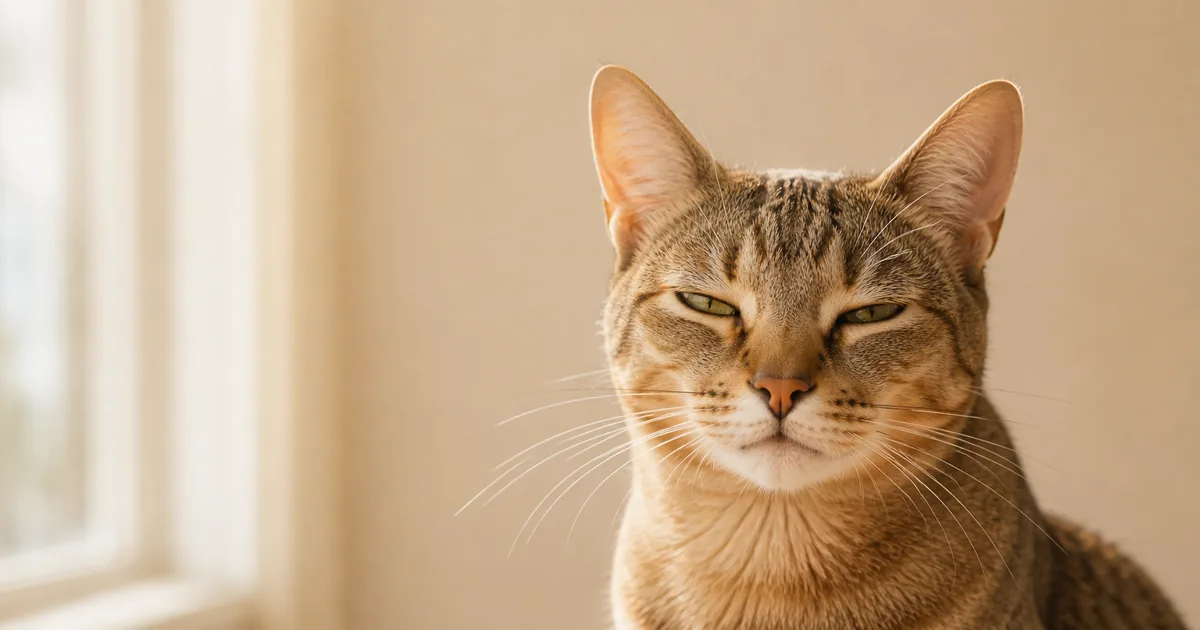
The tail tells you maybe half of what your cat is feeling. The other half is in four channels you might be reading without realising it — ears, whiskers, eyes, and posture. Each is a real signal with a real vocabulary, and once you can read all five, you can read your cat with the kind of fluency most owners never reach.
(If you've ever wondered "does my cat hate me," the five-channel read is the answer. See our blog: Does Your Cat Hate You? What Body Language Actually Means.)
Ears — the directional indicator
Cats have 32 muscles per ear and can rotate each one 180° independently. That’s far more articulation than they need just to hear, and it’s why ears are such a rich emotional signal.
Forward, alert
Ears upright, both pointed forward. Means: focused interest, hunting, curiosity. The cat is paying attention to something specific in front of it.
Neutral relaxed
Ears upright but slightly outward, soft posture. Means: calm baseline. The cat is at ease.
Sideways / "airplane ears"
Ears rotated outward to the sides, slightly back. Means: uncertain, gathering information about a possible threat. Transitional between alert and defensive — watch what the cat does next.
Flat back, pressed against the head
The ears are pulled tight against the skull. Means: fear or aggression — the cat is protecting its ears from a possible fight, and is signalling that escalation is on the table. Combined with a hiss or growl, this is "back off." Combined with a tucked tail, it’s pure fear; combined with a stiff body, it can be aggression.
Twitching or flicking
One or both ears flicking rapidly. Means: irritation, discomfort, or active scanning. A cat with one ear flicking constantly may have an ear infection or ear mites — worth a check-up if it persists.
Whiskers — the sensitivity dial
Whiskers (vibrissae) are mechanoreceptors, but they’re also a low-bandwidth communication channel. Their position correlates predictably with affect:
- Forward, fanned out — interest, curiosity, predatory focus. Often paired with dilated pupils and ears forward. The cat is engaged.
- Neutral, slightly curved sideways — calm baseline.
- Flat / pulled tight against the cheeks — fear, defensive arousal, sometimes pain. Often paired with flattened ears and tucked tail.
Whisker fanning is fast — sub-second — so it’s easier to spot in motion than in static photos. It’s also one of the strongest tells for whether a "stalking" pose is hunting (whiskers forward, engaged) or defensive (whiskers flat, scared).
Bonus: never trim a cat’s whiskers. Length is calibrated to the cat’s body width for spatial navigation; trimming causes brief disorientation. Also note "whisker fatigue" — narrow food bowls force whiskers against the rim, which some cats find unpleasant. Switch to wide shallow bowls; resolves in days.
Eyes — pupils and blinks
Pupil shape and size
Pupil dilation in cats reflects two things: ambient light and emotional arousal. In bright rooms, pupils should be vertical slits. Wide round pupils in a bright room mean the cat is highly aroused — either in play, fear, or pain.
- Slits in normal light: calm, content.
- Wide round pupils + forward ears + crouched hunting pose: engaged predator state.
- Wide round pupils + flat ears + tucked tail: fear.
- Asymmetric pupils (one bigger than the other): not normal — see a vet within 24 hours. Anisocoria can signal neurological issues, eye injury, or systemic disease.
The slow blink
Eyes narrowing slowly, sometimes closing fully, then reopening. The slow blink is a peaceful trust signal between cats and between cats and humans. It says "I’m relaxed, I don’t see you as a threat." Research has shown unfamiliar cats are more likely to approach humans who slow-blink at them — it works.
If you want to send a "we’re good" message to your cat, slowly close your eyes for a beat and reopen them. Cats often blink back.
The hard stare
The opposite of the slow blink. A wide-open, unblinking stare is a challenge or a threat assessment in cat-language. In multi-cat homes, an unblinking stare across a room is often a passive-aggressive resource conflict — the staring cat is communicating "this is mine" without moving. If you have two cats and one stares at the other for 30+ seconds at a stretch, watch for under-the-radar tension.
Posture — the whole-body read
The loaf and its variants
The classic loaf — paws tucked under chest, tail wrapped around the body — is moderately relaxed; the cat is conserving heat and ready to spring up if needed. Common on cool surfaces.
The half-loaf, with one paw out and slight hunching, is uncertain or mildly uncomfortable. A cat that suddenly switches to consistent tight half-loafing may be guarding its abdomen — worth flagging.
The sphinx — lying on belly, paws stretched forward, head up — is alert rest. Short naps in busy households often happen in this pose.
Sploot and full-flop
The sploot — back legs stretched out behind, belly on the floor — is fully relaxed and trustful. So is the side-lie (full-flop), where the cat is on its side with legs extended; this is the deepest relaxation, REM-capable. Both expose the belly, which is the most vulnerable part of a cat’s body — a strong vote of trust in the environment.
Belly-up
The peak trust signal. A cat on its back with paws relaxed in the air is showing the most vulnerable position in its repertoire. Note: this is not always an invitation to rub the belly. Many cats show belly-up as trust but don’t want belly contact — the petting will trigger a defensive grab. Read the tail and tail-tip first.
Arched back, sideways, fur up
Halloween-cat pose. Acute defensive arousal: making itself look bigger to ward off a threat. Combined with a puffed tail and flat ears, the message is "I am scared, do not come closer."
Putting the five channels together
The discipline of body-language reading is cross-checking. The same single signal can mean opposite things in different contexts. Two examples:
Hunting state: low crouched body + wide pupils + ears forward + whiskers forward + tail-tip twitching. All channels say "engaged predator." The cat is locked on prey or play.
Fear state: low crouched body + wide pupils + ears flat + whiskers flat + tail tucked. The body is in the same crouch as the hunting state, but the four other channels reverse the meaning.
Read all five before deciding what your cat is feeling. The tail tells you a lot, but the ears and whiskers tell you whether what the tail is telling you is a positive or negative emotion. The eyes confirm arousal level. The posture grounds it all in the body.
What this changes day-to-day
- You stop getting "surprise-bitten" during petting — the tail twitch and ear-flicks warn you 5–10 seconds before the bite.
- You spot fear at the vet faster, which means you can advocate for a slower, calmer handling approach.
- You catch baseline shifts earlier — a cat whose ears used to be forward and now are constantly sideways may be hearing something different in its environment, or feeling differently about it.
- You can answer the eternal cat-owner question "what is my cat thinking right now" with something better than guessing.
Reading body language is a skill, not a talent. A few weeks of paying deliberate attention and you’ll be fluent enough that it becomes automatic.
Frequently asked questions
Why are my cat’s pupils so big when we’re playing?
Dilated pupils during play are normal — they reflect arousal, not fear. The cat is in a predatory state: focused, energized, locked on the toy. The same dilated pupils paired with flat ears and tucked tail would mean fear; paired with forward ears and a hunting crouch, they mean engaged. Read pupils alongside ears and whiskers, never alone.
What does the slow blink really mean? Is it like a kiss?
A slow blink — eyes narrowing slowly, sometimes closing fully, then reopening — is a peaceful trust signal. It tells another cat (or human) "I’m relaxed, I don’t see you as a threat." Research has shown that humans who slow-blink at unfamiliar cats are more likely to be approached. It’s not exactly a kiss, but the closest cat equivalent: an explicit "we’re good" signal. Try it — your cat will often blink back.
My cat’s ears swivel sideways like an airplane — what does that mean?
"Airplane ears" — ears rotated sideways and slightly back — are a transitional state between alert and defensive. The cat has heard or noticed something it’s not sure about and is gathering information. If the situation resolves (no threat), ears go back forward. If the cat decides it’s a threat, ears flatten further. It’s a "wait, what?" face.
Why does my cat sit in the loaf position so much?
The "loaf" — paws tucked under chest, tail wrapped around the body — is a moderately relaxed resting posture. The cat is comfortable but ready to spring up if needed. It’s most common on cool surfaces (helps conserve heat) and during light naps. A cat that switches from relaxed sploot or side-lie to consistent tight-loafing may be guarding its abdomen — a possible early pain sign worth flagging at the next vet visit.
Triage your cat in under 60 seconds
Not sure if this is an emergency? CatMD runs feline-specific triage on symptoms or photos and returns a 0–99 health score with urgency tier, differentials, and a vet-ready summary.
Get the app