Cat Tail Language: What Your Cat's Tail Is Telling You
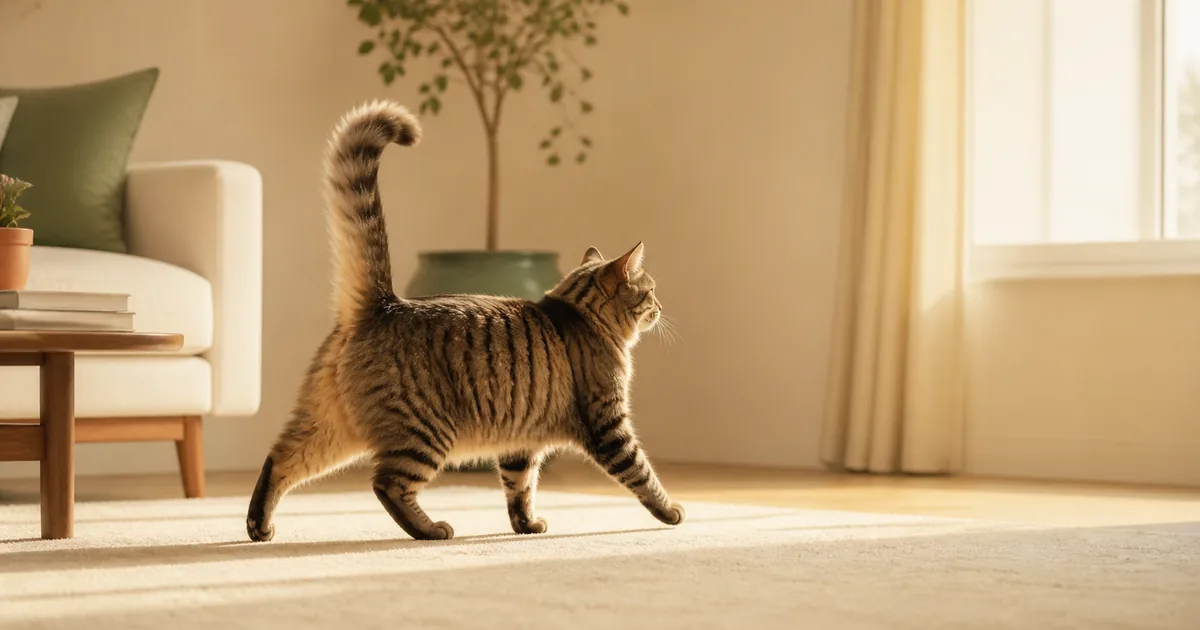
Cats can’t talk, but they’re saying a lot. Of all the channels they use — ears, whiskers, eyes, vocalizations, posture — the tail is the most readable. It’s long, mobile, visible from across a room, and operates on a vocabulary that’s consistent across nearly all domestic cats. Once you can read it, you can read your cat.
This guide covers the seven tail positions every cat owner should know, what each one means, and how to combine tail with other body-language signals to avoid the most common misreads.
The seven positions
1. Tail held high and curved at the tip
A confident, friendly greeting. Often paired with a forward walk, ears forward, and possibly a chirp or trill. Kittens learn this from their mothers; adult cats use it with bonded humans and friendly conspecifics. Means: "I see you, I’m happy you’re here, I feel safe." When your cat does this as you walk in the door, it’s the closest thing in cat-language to a hug.
2. Tail upright with vibrating tip
An intensified version of #1, often seen in unspayed/unneutered cats and intact toms when marking territory — but also seen in spayed/neutered cats during particularly enthusiastic greetings. The vibration is rapid, almost a flutter. Means: excited recognition. Combined with backing up to a wall: territorial marking; if no marking, just a happy hello.
3. Tail held neutrally horizontal or in a relaxed curve
Default cruising posture. The cat is calm, exploring, and not particularly emotionally engaged. Means: "I’m fine, going about my business." Not a strong signal in either direction — just baseline.
4. Tail tucked under the body or wrapped tightly around legs
A tucked tail signals fear, submission, or pain. The cat is trying to make itself smaller and protect a vulnerable body part. Often paired with crouched posture, ears flat or sideways, and dilated pupils. Means: "I feel unsafe right now." In a cat that suddenly starts tucking its tail when picked up or in a particular spot, consider pain — abdominal, urinary, or musculoskeletal.
5. Tail lashing or whipping side-to-side
Fast, large-amplitude side-to-side movement of the whole tail. Often misread as "wagging like a dog." It is not friendly. Means: high arousal, frustration, on the edge of escalation. During petting, a tail lash is the cat’s "I’m done, stop." During cat-to-cat tension, a tail lash precedes a swat. The correct response: stop whatever interaction is happening, give space, and let the cat disengage.
6. Tail puffed up like a bottle brush (piloerection)
Acute defensive arousal: the cat is afraid and is making itself look bigger to ward off a threat. The hair stands on end via the same mechanism that makes humans get goosebumps, but in cats it’s a deliberate display. Often paired with arched back, sideways stance, and ears flat. Means: "I am scared and ready to defend myself." Do not approach. Give space. The puff resolves within minutes once the threat is gone.
7. Tail-tip twitch (the small one)
A small rhythmic flick of the last inch or two of the tail, with the rest of the tail still. This is a graduated tolerance gauge. In a focused predator state (watching a bird, stalking a wand toy), the twitch signals locked-on attention — the cat is engaged. During petting or other handling, a twitch means the cat is approaching the limit of what it wants. The next escalation is a full lash; the one after that is a swat. Means: attention or warning, depending on context. Reading this tip-twitch correctly is the single biggest way to prevent "petting-induced aggression" — the cat almost always warns you before swatting.
The slow swish (a special case)
Distinct from the lash, the slow swish is a wide, deliberate side-to-side movement during focused predatory play. Hunting cats do this just before pouncing on prey — the tail counterbalances the upcoming spring. If your cat is doing this with eyes locked on a wand toy or a bug on the wall, you’re watching the predator sequence in action. Channel it with a toy.
Reading tail in context: the body-language combinations
The single most important rule of body-language reading is this: no signal stands alone. The same tail position can mean very different things depending on what the rest of the body is doing.
- Low crouched body + dilated pupils + forward whiskers + tail-tip twitch: hunting state. The cat is locked on prey (or a toy that triggers the prey response). Engaged and positively aroused.
- Low crouched body + dilated pupils + flat whiskers + tail tucked: fear. Same body crouch, opposite emotional state. The whiskers and tail tell the story.
- Tail high + ears flat: conflict. The cat is approaching but feels uncertain. Read this carefully — don’t reach for them.
- Tail lashing + slow blink: doesn’t happen — these are mutually exclusive emotional states. If you think you’re seeing both, look again.
What about during sleep?
Sleeping cats often hold their tails wrapped around their bodies or tucked under their chins. This is thermoregulation and habit, not emotional signalling. The tail-language vocabulary is for the awake cat; ignore tail position during deep sleep.
The cheat-sheet
| Tail position | Most likely meaning |
|---|---|
| Up + curved tip | Confident greeting |
| Up + vibrating | Excited recognition (or marking) |
| Horizontal / relaxed curve | Calm baseline |
| Tucked / wrapped tightly | Fear or pain |
| Lashing / whipping | Frustration / "stop" |
| Puffed bottle-brush | Acute defensive fear |
| Tip twitching only | Attention or rising tolerance limit |
What this lets you do
Once you can read the tail, three things change. First, you stop misreading "wagging" as friendly — your cat will stop biting you mid-pet, because you’ll back off when the twitch starts. Second, you start spotting fear earlier — a tucked tail at the vet’s office is a cue to slow the handling, not push through. And third, you notice when the baseline shifts — a normally tail-up cat that suddenly starts tail-tucking is telling you something is wrong, often before any other symptom appears.
The tail is just one channel. The next piece in this series covers the other four — ears, whiskers, eyes, and posture — and how to put them together into a complete read of your cat. (Curious how AI does this from a photo? See how body-language reader apps work.)
Frequently asked questions
Does a wagging tail mean a cat is happy, like a dog?
No — the opposite. In dogs, a wagging tail signals enthusiasm and friendliness. In cats, a fast-lashing or whipping tail is one of the clearest "I am annoyed, stop now" signals. Slow side-to-side swishes during play are different (focused predatory engagement). The visual is similar; the meaning is reversed.
What does it mean when a cat’s tail tip twitches?
A small rhythmic twitch confined to the last 1–2 inches of the tail is a graduated tolerance gauge. During focused attention (watching a bird, stalking a toy) it signals locked-on engagement. During petting, a tail-tip twitch is the early warning that the cat is approaching its tolerance limit — the next escalation is a full lash, then a swat. Caregivers who learn to spot it can disengage before the cat escalates.
Why does my cat hold their tail straight up when I come home?
Tail held high and curved at the tip is a friendly social greeting — it’s a confidence signal cats use with bonded humans and friendly cats. Kittens learn it greeting their mother. If your cat does this when you walk in, it means they’re happy to see you and feel secure. The slight curve at the tip is the difference between a confident greeting (curve) and a more neutral upright posture (no curve).
My cat’s tail is puffed up like a bottle brush — what should I do?
A bottle-brush tail (piloerection) is acute defensive arousal: the cat feels threatened and is making itself look bigger. Common triggers: another animal (cat, dog, raccoon), sudden loud noise, an unfamiliar visitor, vacuum cleaner. Do not approach or pick up the cat — give it space and a clear escape route. The tail puff drops within minutes once the threat is gone. If it persists or recurs frequently, look for a household stressor (new pet, schedule change, blocked sightline to another cat).
Do cats use their tails to communicate with other cats?
Yes — cat-to-cat tail signalling is well-documented. Tail-up greetings, tail-wrap (one cat draping its tail over another’s back, a peaceful affiliative signal), and tail position during pass-bys all carry meaning. In multi-cat homes, watching the tails during a doorway encounter tells you whether the relationship is friendly (tails relaxed or up) or tense (lashing, low-held, or puffed).
Triage your cat in under 60 seconds
Not sure if this is an emergency? CatMD runs feline-specific triage on symptoms or photos and returns a 0–99 health score with urgency tier, differentials, and a vet-ready summary.
Get the app