Cat Breathing Fast: The 30 bpm Rule
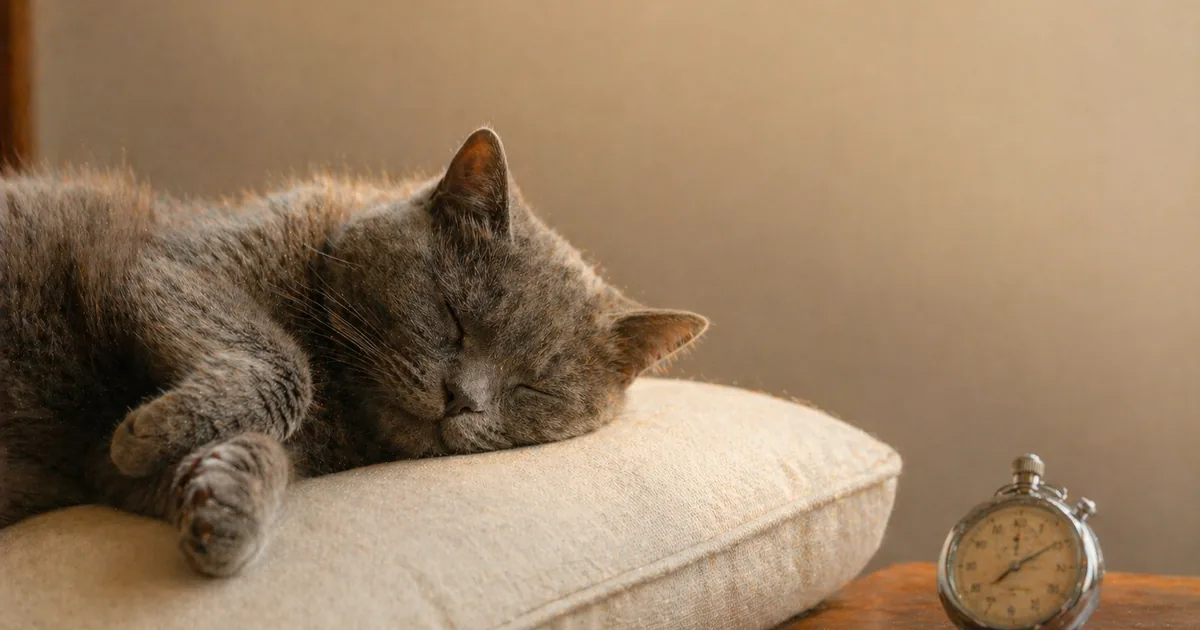
There's a single number most cat parents have never heard of but every cardiologist knows: 30 breaths per minute while your cat is sleeping or resting. Consistently above that, especially in predisposed breeds, is one of the earliest signs of hypertrophic cardiomyopathy (HCM) — the most common heart disease in cats and a leading cause of sudden death.
How to measure sleeping respiratory rate
Wait until your cat is fully asleep (not just resting — asleep). Watch the chest or belly rise and fall. Each full rise-and-fall = one breath.
- Count for 30 seconds, multiply by 2 → breaths per minute
- Take 3 measurements across different sleep sessions for a reliable baseline
Do not measure during purring or active dreaming (twitchy REM phase).
What's normal
- Healthy cat, asleep: 15–30 breaths per minute. Most sit around 20–25.
- Healthy cat, awake and resting: 20–30 bpm
- Panting in cats: almost always abnormal. Cats do not pant like dogs.
The threshold to remember: 30 bpm asleep.
Why it's specifically an HCM early signal
HCM thickens the heart muscle, which reduces how much blood the heart can hold and pump per beat. The body compensates by breathing faster to deliver more oxygen per minute. This shows up in sleep — when metabolic demand is otherwise lowest — as an elevated baseline respiratory rate.
By the time the cat is audibly breathing hard, the disease is usually advanced. The 30 bpm threshold catches it earlier.
Breeds at elevated HCM risk
- Maine Coon — genetic MYBPC3 mutation, ~35% prevalence
- Ragdoll — different MYBPC3 mutation, high prevalence
- Sphynx — high prevalence, underdiagnosed
- British Shorthair
- Persian
- American Shorthair
- Norwegian Forest Cat
Any mixed-breed cat can develop HCM, but breed cats from above lines should have at minimum one cardiologist echocardiogram, ideally every 1–2 years.
The tracking protocol
- Once a week, measure SRR over 30 seconds while the cat is deeply asleep
- Record the number
- If the running average starts climbing over 1–2 months, schedule a cardiology workup
- If any single reading is consistently above 40, call the vet within a day
- If above 50 or paired with any distress, emergency vet
For predisposed breeds, weekly tracking from age 2 onward catches problems early.
Distinguishing HCM from other causes
- Pleural effusion (fluid around the lungs)
- Pulmonary edema (fluid in the lungs — left-sided heart failure)
- Feline asthma (real and common)
- Pneumonia
- Pulmonary contusion (trauma)
- Chylothorax
- Diaphragmatic hernia
- Anemia — pale gums confirm
- Pain
- Fever
- Hyperthyroidism
- Sleeping respiratory rate above 50
- Breathing with open mouth
- Breathing with elbows splayed out (orthopneic posture)
- Abdominal heave (belly working hard to breathe)
- Blue or pale gums + fast breathing
- Collapse or inability to rise
- Sudden hind-limb weakness or paralysis (aortic thromboembolism — HCM complication)
Aortic thromboembolism (ATE / saddle thrombus) deserves special mention. Cats with HCM can throw a clot that lodges at the aortic bifurcation, cutting blood flow to the hind legs. Sudden hind-leg weakness + crying out + cold hind paws = immediate emergency.
What to record for your vet
Record the respiratory rate, whether the cat was asleep or awake, the time of day, and whether purring or dreaming may have affected the count. If the number is high, take a short video of the chest and belly movement. Vets can often tell from the video whether the breathing pattern looks shallow, effortful, abdominal, or open-mouth.
Do not force handling if the cat is struggling to breathe. Stress raises oxygen demand. Keep the carrier ready, call ahead, and move calmly.
Trend beats one reading
A single reading of 32 after play is less useful than a sleeping baseline that moved from 22 to 34 over two weeks. CatMD's diary and health notes are meant for exactly this kind of quiet drift: the number, the context, and the date together.
If your cat is a Maine Coon, Ragdoll, Sphynx, or another HCM-risk breed, weekly sleeping respiratory rate is one of the simplest home signals worth tracking.
Triage your cat in under 60 seconds
Not sure if this is an emergency? CatMD runs feline-specific triage on symptoms or photos and returns a 0–99 health score with urgency tier, differentials, and a vet-ready summary.
Get the app