Why Is My Cat Suddenly Affectionate? 7 Reasons
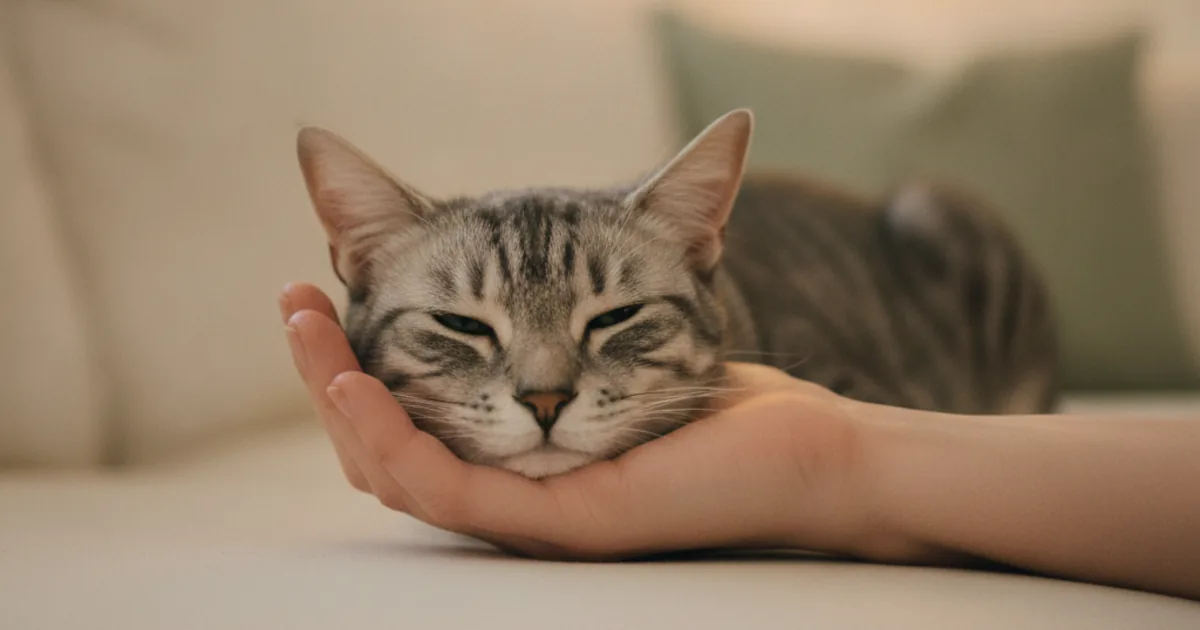
Your cat has been the same cat for six years. Slightly aloof. Comes when she wants something. Doesn't mind being petted but doesn't seek it out. Then one week she starts following you from room to room, sleeping on your chest, head-bumping your hand every time you sit down.
This is one of the more confusing behaviour shifts cat owners encounter, partly because the obvious interpretation ("she finally loves me!") competes with the slightly worrying one ("is something wrong?"). The honest answer is: it depends which cause is driving it. There are seven common ones. Most are benign. Two of them are signals worth acting on.
The seven causes, ranked roughly by likelihood
1. Weather and body heat seeking
The most common cause, especially in cooler months. Cats are warmth-seekers — their thermoneutral zone (the temperature at which they expend no energy regulating body heat) is roughly 30-38°C (86-100°F), which is significantly warmer than most homes. Your body runs at 37°C all the time. When the ambient temperature drops, your warmth becomes one of the most valuable real estates in their territory.
How to tell: the affection-seeking intensifies on cold days, eases on warm days, and is concentrated on whichever part of you is warmest. The cat often positions back-to-you to maximise contact area rather than facing you. True affection seeking faces you. Heat seeking gets comfortable.
Action: none needed. Enjoy it. Optionally provide a heated bed or a sunny window perch — many cats will redistribute their affection accordingly.
2. Household or routine change
Cats are routine-driven. A move to a new home, a new person in the household, a partner who started travelling, a schedule shift (your work-from-home changed to office, or vice versa) — any of these can trigger increased clinginess as the cat re-establishes their sense of safety. You're a fixed point in a changed environment, so they stay close to you.
How to tell: the change started within 1-4 weeks of a household shift. Usually paired with other anxiety signs — hiding when you're not home, increased vocalisation, sometimes appetite changes. Settles back to normal within 4-8 weeks as the cat adjusts.
Action: nothing dramatic. Maintain a predictable routine where you can. Feed at the same time each day. Provide vertical territory (cat trees, high shelves) where the cat can observe from a safe distance. Most cats settle on their own within two months. If the clinginess is paired with stress-related behaviours like inappropriate urination or aggression, talk to a vet about whether environmental enrichment or short-term anxiolytic medication might help.
3. Illness or pain seeking comfort
This is the cause worth paying close attention to. Some cats, when they don't feel well, withdraw and hide (see our guide on hiding as an illness sign). Others — sometimes the same cats — seek closeness for warmth and reassurance. The behaviour pattern is rooted in pre-domestication: vulnerable animals stay near their group.
How to tell: the new affection is paired with at least one other change. Look for reduced appetite, weight loss, changes in water consumption, litter box differences, reduced grooming, hesitation before jumping, or subtle facial pain signs (ears slightly back, eye narrowing, muzzle tension). If two or more of these are present alongside the new affection, it's a vet conversation.
Action: a vet visit with a full wellness panel including weight, blood pressure, urine specific gravity, and (in cats over 7) a thyroid and kidney panel. Don't wait for the cat to look obviously sick — the cats who become affectionate-when-sick are often the same cats who hide the sick part well.
4. Pregnancy (in unspayed females with outdoor access)
Pregnant cats often become noticeably more affectionate, especially in the first 2-3 weeks. The hormonal shift drives both clinginess and nesting behaviours. This applies only to intact (unspayed) females with access to outdoor males.
How to tell: in addition to increased affection, watch for nipples turning pinker and slightly enlarged around day 15-18 ("pinking up"), increased appetite that builds week over week, seeking out warm enclosed spaces, and around week 4-5, a noticeably rounder belly.
Action: if pregnancy is plausible, your vet can confirm via palpation or ultrasound by around day 20-25. Prenatal nutrition (kitten food, which is calorie-dense), a quiet nesting spot, and a vet plan for the birth itself are the practical next steps.
5. Heat (also unspayed females)
Cats in oestrus ("heat") are often dramatically more affectionate — but the body language is different from pregnancy or general clinginess. Heat cats roll on their backs, vocalise loudly (often constantly), present their hindquarters, and pace restlessly. The affection is intense but specifically sexual-presentation behaviour.
How to tell: if she's an unspayed female and the behaviour includes rolling, very loud yowling, and presenting, it's probably heat. Heat cycles in cats last 4-7 days and can recur every 2-3 weeks in spring and summer.
Action: the only durable solution is spaying. Multiple heat cycles without breeding increase risk of pyometra (uterine infection) and mammary cancer.
6. Reinforced affection routine
If you've recently started rewarding affection (giving treats, prolonged petting sessions, opening the bedroom door when they head-bump it), the cat has learned that the behaviour produces outcomes they like. They will repeat it. This is operant conditioning in real time.
How to tell: the affection-seeking concentrates around specific triggers (you sitting down, you in the kitchen, you in bed) and the behaviour is goal-directed rather than just companionable. The cat shows up affectionate, gets the outcome, and leaves.
Action: nothing wrong with it. Just be aware that the behaviour will stay as long as it pays off. If you'd like to redirect it (because the cat now demands attention at 5 AM), the principle is the same as breaking any reinforced behaviour: stop responding to it consistently for 2-3 weeks. There will be an extinction burst (the behaviour gets worse before it gets better). After that, it fades.
7. Cognitive change in older cats
In cats over 10, sudden affection-seeking can be one face of feline cognitive dysfunction syndrome (CDS). The cat becomes disoriented, anxious about being alone, and seeks reassurance from familiar humans. This is usually paired with other CDS signs: nighttime yowling, staring at walls, occasional accidents outside the litter box, sleep-wake cycle disruption. See senior cat care after age 10 for the full picture.
How to tell: cat is over 10, the affection-seeking has anxious quality to it (rather than warm-content), and other senior-cat behaviour changes are present.
Action: vet visit with a senior workup. CDS is manageable — diet changes (omega-3, antioxidants), environmental enrichment, night lights, predictable routines, and in some cases medication can meaningfully reduce symptoms.
How to decide what's driving it
The triage shortcut for most owners:
| Pattern | Likely cause | Action |
|---|---|---|
| Intensifies on cold days, eases on warm | Heat seeking | Enjoy it |
| Started within 4 weeks of a household change | Routine adjustment | Patience, stable routine |
| Paired with any appetite/litter/grooming change | Possible illness | Vet visit |
| Unspayed female, recent outdoor access | Pregnancy or heat | Vet visit for confirmation |
| Cat is over 10, paired with disorientation | Cognitive dysfunction | Vet visit, senior workup |
| Started after you gave new treats/attention | Reinforced learning | Optional — consistent response |
The single most important question to ask: "is the affection paired with any other change?" Pure clinginess on its own is almost always benign. Clinginess plus any other change is usually a vet conversation.
Reading the affection itself
Affection behaviour in cats has several distinct flavours, and learning to tell them apart helps decode what's driving it:
- Warm/content: head bumps, slow blinks, kneading, soft purr, faces you, relaxed body. This is true bonding.
- Anxious: sticks close but doesn't settle, vocalises, follows obsessively, pupils dilated, ear position alert. This is reassurance-seeking.
- Comfort-seeking (illness): quiet proximity, lower energy than usual, often presses against you without engaging, may purr (cats purr when sick as a self-soothing behaviour). Usually paired with reduced activity overall.
- Heat-seeking: positions back-to-you, maximises contact, often falls asleep — affection without the engagement.
- Heat (oestrus): rolling, loud vocalisation, presenting, restless — usually obvious if you've seen it before.
If you're not sure which flavour you're seeing, watching for a few days usually clarifies it. The benign causes settle into a pattern. The medical causes drift.
What CatMD does here
CatMD's Health Rhythm view tracks mood, appetite, water, litter, and behaviour over weeks. When a cat suddenly becomes affectionate, the question is rarely "is the affection itself a problem" — it's "is anything else drifting at the same time?" The longitudinal picture catches the answer that the daily eye misses.
The Body Language reader can interpret a 6-second video of how your cat is moving, holding their ears, and using their tail right now — useful when the affection has an anxious quality you can't quite name. The chat surface uses your cat's personality profile to talk back in her voice, which is its own kind of bonding when she's seeking proximity.
Free to start. Get CatMD on iOS or Android if you want one app that watches the patterns alongside you.
Editorial note: This article is educational content, reviewed against peer-reviewed feline behavioural sources (Bradshaw & Turner, The Domestic Cat: The Biology of its Behaviour), AAFP behavioural guidelines, ISFM behaviour position papers, and Cornell Feline Health Center. It is not a substitute for veterinary diagnosis or treatment. In a medical emergency, contact a licensed veterinarian immediately.
Frequently asked questions
Is it bad if my cat is suddenly more affectionate?
Not always — but it's worth paying attention to, especially in adult cats who weren't previously cuddly. Sudden behaviour changes in cats are more often physiological than psychological. The seven most common causes below cover the full range, from completely benign (weather, your scent, attachment routine) to medical (illness, pregnancy, pain seeking comfort). The rule of thumb: if the affection is paired with any other change — appetite, litter, energy, grooming — it's worth a vet conversation.
Do cats get clingy when they're sick?
Some do. Other cats withdraw when sick (see our guide on <a href="/library/cat-hiding-illness">cat hiding as an illness sign</a>). The cats who get clingy when sick are usually doing one of two things: (1) seeking warmth and comfort because they feel unwell — sick cats often want body heat and a quiet presence; (2) sticking close because their predator instincts tell them to be near their group when vulnerable. Both behaviours predate domestication. If your normally independent cat suddenly wants to be touching you all the time, look for other changes — appetite, litter, breathing, grooming — to decide whether this is the medical version.
Could my cat be pregnant if she's suddenly affectionate?
Possible if she's an unspayed female with outdoor access. Pregnant cats often become noticeably more affectionate, especially in the first 2-3 weeks of pregnancy. Other signs include enlarged or pinker nipples ("pinking up" — usually around day 15-18), increased appetite, and seeking warm enclosed spaces. Cats in heat can also be unusually affectionate, but the body language is different — heat cats often roll, vocalise loudly, and present their hindquarters. If pregnancy is a possibility, your vet can confirm with an ultrasound or palpation by around day 20-25.
Why does my cat want to be on me all the time now?
Common triggers: a recent change in your household (move, new person, schedule shift) that made them anxious; weather change that makes your body heat more appealing; an undiagnosed health issue that's making them seek comfort; or simply that your routine has aligned with theirs in a way that reinforced the behaviour. Pattern-recognition tip: cats who get clingy because of anxiety usually pair it with hiding when alone, increased vocalisation, or appetite changes. Cats who get clingy for comfort/warmth reasons usually still behave normally otherwise.
Is my cat being affectionate because they're in pain?
Possible — pain-driven affection-seeking is real, especially in cats with chronic conditions like arthritis or dental disease. The cat seeks proximity for warmth and reassurance without showing obvious distress signs. Look for paired indicators: hesitation before jumping or climbing; grooming gaps over the back and hips; sleeping in lower or more accessible spots; reduced play interest; subtle facial signs from the Feline Grimace Scale (ear flattening, eye narrowing, muzzle tension). If the affection started around the same time you noticed any of these, treat it as a vet conversation, not a personality shift.
How can I tell if my cat is being affectionate or just cold?
Cold-seeking affection has a recognisable pattern: it intensifies on cool days, lessens on warm days, and is concentrated on whichever part of you is warmest (lap, neck, armpit). The cat positions for heat first, affection second — they'll often turn their back to you to maximise contact area rather than face you. True affection seeking has a different posture: facing you, slow blinks, head bumps, kneading, soft eye contact. Cats can be both at once, but the temperature-driven pattern is usually obvious if you watch for a week.
Triage your cat in under 60 seconds
Not sure if this is an emergency? CatMD runs feline-specific triage on symptoms or photos and returns a 0–99 health score with urgency tier, differentials, and a vet-ready summary.
Get the app