Cat Vocalizations: Meow, Chirp, Purr
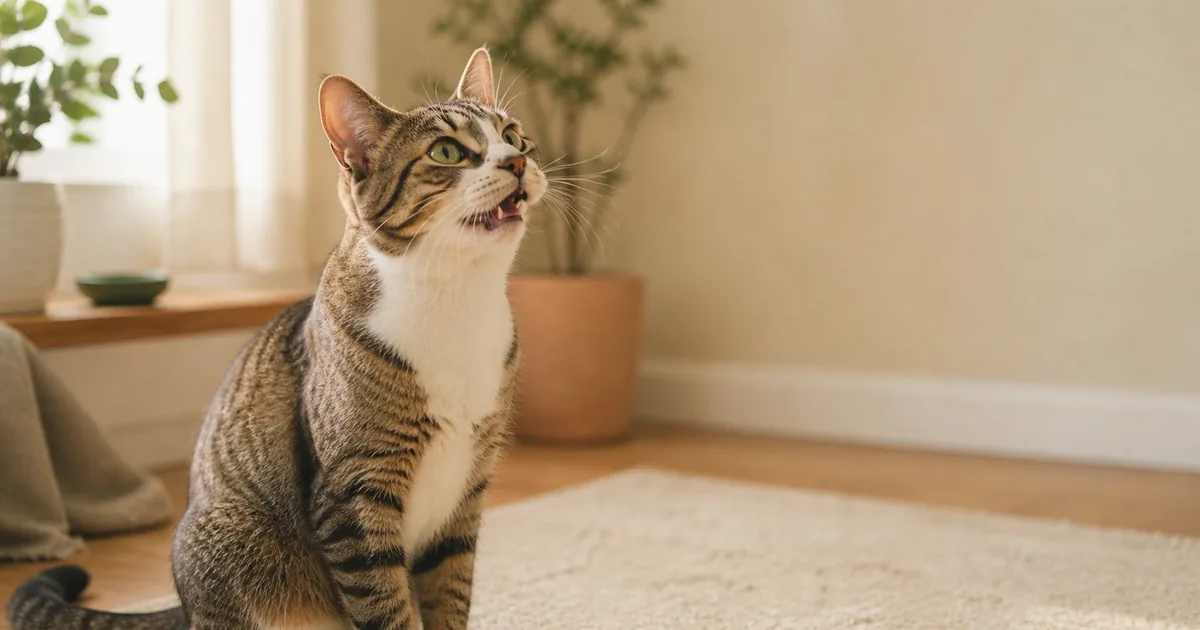
Cats are not silent. They produce 21+ distinct vocalisations, but the everyday repertoire most owners encounter reduces to about eight sounds with consistent meanings. Knowing the vocabulary tells you whether your cat is greeting, asking, complaining, threatening, or self-soothing — and lets you spot when their baseline shifts.
The eight everyday sounds
1. Meow
The all-purpose request. Pitch and length carry meaning: a short clipped meow is usually attention-asking, a long drawn-out meow is complaint or distress, a high-pitched chirpy meow is greeting. Most owners learn their own cat’s specific meow vocabulary within months — it tends to be remarkably consistent per individual. Worth noting: adult cats almost never meow at each other — they keep the meow channel almost exclusively for humans (see why your cat meows at you specifically).
2. Chirp / trill
A short rolled "brrrr" or "prrrrt", mouth closed. Originally a mother-to-kitten "come here" call; adult cats use it as a friendly greeting toward bonded humans and friendly cats. Almost always a positive signal.
3. Purr
Continuous low-frequency vibration on inhale and exhale (distinct from a growl, which is exhale-dominant and more strained). Critically: purring is bidirectional self-soothing — cats purr in distress as much as contentment. A cat purring at the vet, after surgery, or while injured isn’t happy; it’s coping. Read alongside posture, ears, and tail; never alone.
4. Growl
Low sustained rumble, exhale-dominant, distinct from purring. A clear warning. The cat is asking for distance — see the body-language cards on hissing + growling for the full escalation hierarchy. Almost always paired with flat ears and a defensive body shape.
5. Hiss / spit
Sharp forced exhale through an open mouth. Defensive — the cat is asking the threat to back off without escalating to a fight. Spitting is the more abrupt single-explosion variant, usually triggered by sudden surprise.
6. Yowl
Long mournful call, often louder and more drawn-out than a meow. Three main contexts: distress (cat in pain or trapped), mating call in unspayed/unneutered cats, and — in senior cats — sometimes a sign of cognitive decline, hyperthyroidism, or sudden blindness from hypertension. Sudden new yowling in an older cat is always worth a vet check, never "just aging."
7. Chatter
Rapid teeth-clicking with visible jaw vibration. Almost exclusively triggered by watching prey through a window — birds, squirrels, bugs. A frustrated predatory state. Some researchers think the jaw motion mimics the killing-bite. Not communication; just the cat’s predatory wiring firing without an outlet.
8. Scream
A piercing high-pitched shriek. In a non-breeding household, this is pain — abrupt severe pain (paw caught, tail trodden, sudden injury). Vet emergency unless the cause is obvious + brief. In breeding contexts, female cats can scream during or after mating; the male’s barbed penis triggers it. Not normal in spayed cats.
The single most surprising fact about cat communication
Adult cats almost exclusively meow at humans, not at other cats. Cat-to-cat communication in the wild is dominated by body language and scent — meowing is largely absent between adult conspecifics. Kittens meow at their mothers; mothers respond. As cats mature, the meow drops out of cat-cat communication.
The exception is humans. Cats appear to have retained the meow because we respond to it. Domestic cats developed an expanded meow repertoire specifically to manipulate human caregivers — distinct meows for "feed me", "open the door", "pay attention", "I’m bored." This is a form of cross-species learning unique to cats among domestic animals.
Practical implication: if your cat is "not vocal", that’s usually fine. A confident, low-stress cat with predictable schedules has less reason to issue requests. Vocal frequency is largely breed-driven (Siamese / Tonkinese / Burmese are famously loud; British Shorthair / Russian Blue / Persian are quiet) and individually variable.
Vocal patterns that warrant attention
Track the cat’s baseline. Concern is mostly about CHANGES, not absolute volume:
- Sudden increase in middle-aged or senior cats: hyperthyroidism (early restless phase), hypertension (sometimes secondary to retinal detachment + disorientation), feline cognitive dysfunction in seniors. Vet workup with bloodwork + blood pressure.
- Persistent night vocalisation: see above. Particularly common at 14:00-16:00 (hyperthyroid restlessness peak) or 03:00-05:00 (cognitive dysfunction or pre-dawn hunger).
- New yowling on touch or in a specific area: localised pain. Note the body region; that’s where to direct vet examination.
- A vocal cat going silent: equally telling. A previously chatty cat that goes quiet may have hearing loss (especially white cats with blue eyes — congenital deafness rate is high), pain, or systemic illness affecting energy.
Reading vocalisations alongside body language
Sound rarely stands alone. The same "meow" can mean different things depending on context:
- Meow + tail-up + cheek-rub at 7am → "feed me" + greeting
- Meow + dilated pupils + retreating → distress / fear
- Meow + half-closed eyes + slow approach → "I’m here, attention please"
- Persistent yowl + vocal pacing + new behaviour → flag for vet
The vocal vocabulary is the one channel where the vocabulary is directed at you specifically — your cat learned over the months you’ve known them which sounds get which response. Pay attention to the meows you hear most; that’s your cat’s personalized requests dictionary.
What this changes day-to-day
Once you can read the vocabulary, two things happen. First, you stop dismissing or over-reacting to specific sounds — chatter at the window isn’t distress, a hiss at the new vacuum isn’t pathological, persistent night yowling in an older cat isn’t "just getting old." Second, you spot baseline shifts faster: a normally chatty cat that goes quiet, or a quiet cat that suddenly yowls at 3am, becomes a clear flag rather than ambient noise.
Body language tells you what your cat is feeling. Vocalisations tell you what your cat is asking for. Together they’re fluency.
Frequently asked questions
Why does my cat purr when they’re hurt or stressed, not just when happy?
Purring is bidirectional self-soothing — cats purr in distress as much as in contentment. The vibration frequency (25-150 Hz) overlaps with frequencies shown to promote tissue healing in humans, and there’s strong evidence cats purr to calm themselves during fear, pain, or recovery. A cat purring at the vet isn’t happy — it’s coping. Read purring alongside the cat’s posture, ears, and tail; don’t take it as a standalone "everything’s fine" signal.
My cat doesn’t meow much. Is something wrong?
Probably not — cats vocalise toward humans much less than humans assume they should. A confident, well-adjusted cat with predictable feeding times and no unmet needs may meow only a few times a day. Vocal frequency is largely individual + breed-driven (Siamese / Tonkinese / Burmese are loud; British Shorthair / Russian Blue are quiet). Concern only if the cat WAS vocal and now isn’t (a vocal-baseline drop in a senior cat warrants a check-up — possible hearing loss, neurological change, or systemic illness).
What does it mean when my cat chatters at birds through the window?
Chattering — that rapid teeth-clicking with the jaw vibrating — is a frustrated predatory state. The cat sees prey it can’t reach. Some researchers think it’s an instinctive practice of the killing-bite jaw motion (cats kill rodents and small birds with a precise neck-bite that requires fast jaw articulation). It’s normal, harmless, and doesn’t indicate distress — but if your indoor cat does it constantly at the window, consider increasing structured wand-toy play to give the predatory drive an outlet.
My senior cat has started yowling at night. Is this normal aging?
No — sudden new yowling in an older cat is a flag, not "just aging." Three main causes worth screening: hyperthyroidism (overactive thyroid causes restlessness + nighttime activity + vocalisation), hypertension (sometimes secondary to retinal detachment causing sudden blindness, leading to disorientation), and feline cognitive dysfunction (FCD — the cat dementia equivalent, with disorientation and lost diurnal rhythm). All three are treatable. A senior wellness exam + bloodwork + blood pressure check usually identifies which.
Triage your cat in under 60 seconds
Not sure if this is an emergency? CatMD runs feline-specific triage on symptoms or photos and returns a 0–99 health score with urgency tier, differentials, and a vet-ready summary.
Get the app