Do Cats Remember Their Owners? The Science of Feline Memory
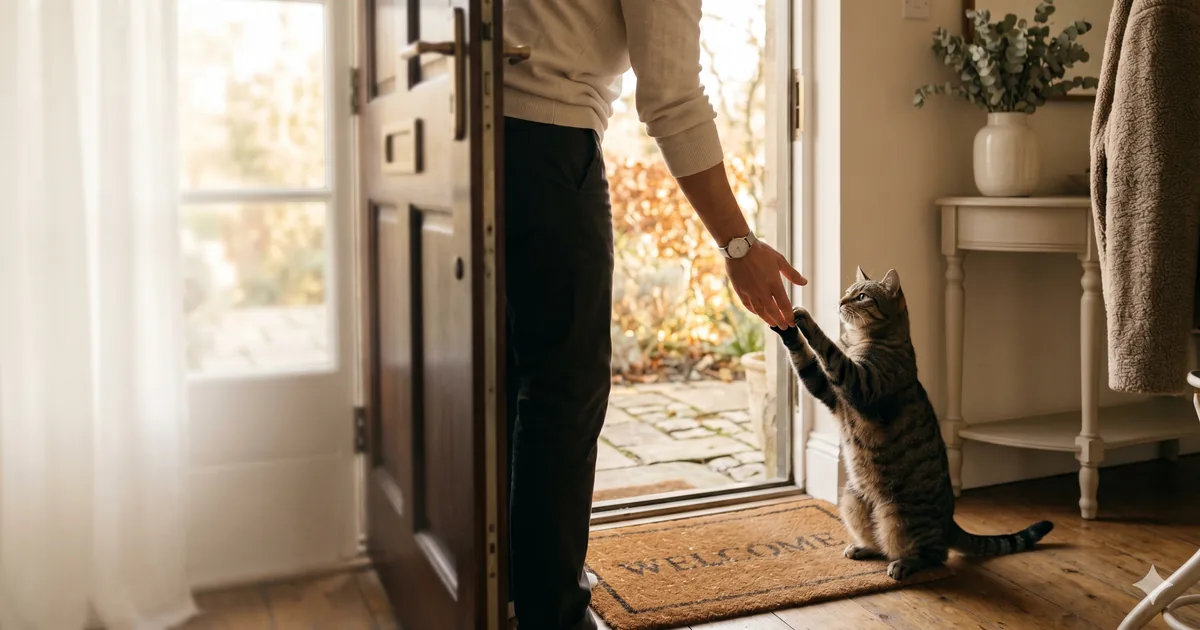
You go on a two-week trip. Comes back. Your cat looks at you, blinks slowly, and resumes the nap he was taking. Did he miss you? Did he know you were gone? Does he even remember who you are? The science says yes to all three — but it's more interesting than a yes-or-no answer suggests.
The four kinds of feline memory
Memory in cats — like in humans — isn't one thing. Modern feline cognition research breaks it into four functional systems:
1. Working memory (short-term)
Approximately 16 hours for high-salience information — where you put a treat, where the wand toy went, which room you went into 10 minutes ago. This is roughly comparable to dogs in studies that have tested both species. Lower-salience information fades faster, sometimes within minutes.
2. Associative memory (medium to long-term)
Pairing a stimulus with an outcome. The sound of the can opener means food. The carrier means the vet. The car means the carrier means the vet, which is why cats can panic when you start your engine. Associative memory in cats is durable — pairings learned in kittenhood persist into old age. This is why early socialization is so consequential: the cat who associates men-with-deep-voices with the volunteer who fed her at the shelter at age 8 weeks will be friendly to such men for life. The cat with the opposite early association will not.
3. Spatial memory (long-term)
Cats who lived in a home and were rehomed years later have demonstrated, on return, the ability to navigate the original space — finding the kitchen, the food location, the favorite resting spot — with no orientation period. Spatial memory in cats appears to be functionally permanent for high-traffic environments.
4. Social memory (the one that matters for "do they remember me")
This is where it gets interesting. Cats recognize specific individuals — humans, other cats, dogs — and retain that recognition across separation. Recognition is multi-modal:
- Scent. Cats use scent more than humans realize. A returning owner who smells "right" is recognized faster than one who came back from somewhere with strong unfamiliar smells (a hospital, a different climate, a new home).
- Voice. Cats discriminate their owner's voice from a stranger's with statistical reliability — even when they don't outwardly respond. A 2019 study from the University of Tokyo found cats showed recognizable signs of attention (head movement, ear rotation) when hearing their owner's voice from another room, but minimal response to a stranger's voice giving the same speech.
- Facial recognition. Less developed than canine facial recognition, but functional. Cats use a combination of facial features and gait/body shape to identify familiar humans.
- Behavioral signature. The way you walk, the rhythm of your evening routine, your posture when you sit on the couch — all of these are identification cues for a cat.
What a cat actually remembers about you
Less than you think; more than you fear. A cat doesn't hold a narrative memory of "the time we went on that walk" or "the day I came to live with you." What a cat retains is:
- Your sensory signature — scent, voice, gait, presence shape
- Your emotional valence — are you safe, are you fun, are you a source of conflict
- Your routines — when you usually feed her, when you usually leave, when you come home, when you go to bed
- Your role in shared spaces — which room is yours, which chair, which side of the bed
- Cumulative associative weight — every time you do something good, the bond strengthens slightly; every time you do something bad, it weakens slightly. Over years, this builds a deep, persistent valence.
What she does NOT retain: episodic narrative ("yesterday we did X"), abstract knowledge of you ("Mom is a software engineer"), or emotional resentment in the human sense (she doesn't hold a grudge about that one time you stepped on her tail — she just learned to be slightly more cautious of feet).
The reunion question: do they miss you?
Yes. The behavioral evidence is consistent. Cats whose owners go away for extended periods show measurable changes — reduced eating, more time hidden, less play, vocalizations directed at the door — that resolve when the owner returns. Some cats are more demonstrative on reunion (rubbing, vocalizing, following) and some are less ("oh, you're back, I'm sleeping"), but the underlying attachment system is well-documented across studies.
The cat who looks at you nonchalantly when you come home from a two-week trip is not indifferent. She's either (a) a less-demonstrative individual, (b) processing the return through scent first (give her a few minutes), or (c) maintaining feline composure because dramatic reactions aren't her register.
Special cases worth knowing
Reunions after months or years
Long-term separations are well-tolerated when the cat's environment is stable in your absence. A cat who stayed in her home with a familiar caretaker remembers the original owner on return — multi-week studies suggest recognition is essentially intact. A cat who was placed in a new environment during the separation may take longer to relax, but the recognition itself is preserved.
Multi-cat reunions
Cats who lived together for years and were separated retain individual recognition. Reunion behavior depends on the original relationship — bonded pairs reunite warmly; cats who barely tolerated each other resume barely tolerating each other. The complicating factor is scent: a cat returning from a vet visit smelling unfamiliar can be temporarily mistaken for a stranger by a former housemate, sometimes triggering aggression. A guide on multi-cat household reintegration covers this in detail.
Trauma memory
Cats with abuse histories show specific-trigger fear responses (men, brooms, certain sounds, the smell of alcohol) that can persist for years. With consistent counter-conditioning — calm exposure paired with positive associations, often over 6-12 months — most cats achieve substantial recovery. The cat is not "stuck" with the trauma; her nervous system can be reshaped by accumulated positive experience.
Why this matters for the modern cat owner
Understanding feline memory changes how you build the relationship:
- Your routines matter more than your moments. She doesn't remember the dramatic Christmas-morning play session — she remembers the consistent 7pm wand-toy ritual.
- Scent management is real. Coming home from the vet, the doctor, a friend's house with a different cat — her behavior toward you isn't indifference, it's scent re-orientation.
- Stability accumulates. Every uneventful day in the same home, with the same routines, with the same people, deepens her sense of safety. The cat who has lived with you for five years is not just five years older — she is five years more confident.
- Loss is real. Cats grieve when a household member dies or leaves permanently. Watch for changes in eating, vocalizing, hiding, sleep. Most cats recover within weeks; some take months. Loss-related behavior changes can mask developing illness — worth a vet check if symptoms persist past three weeks.
What modern AI cat apps add
The challenge with feline memory from the owner's side is that you can't directly query it. Your cat can't tell you "I remember the green chair we had three apartments ago." But the signals are there if you look — what she chooses to be near, who she greets, what triggers her tail-up confidence stance.
Apps like CatMD build a digital memory of your cat — her personality archetype (one of seven well-validated profiles, see the Feline Five framework for the science behind these), her household members (people and other pets she's tagged in photos), the objects and places in her world (silently extracted from your photos over time), and her health history. The app references this memory back to you in conversation: "Yes, Mom was here three days ago — she brought the loud bag." The cat in the app remembers in the way you wish your real cat could tell you what she remembers.
It's not a replacement for the real bond. But it surfaces what your cat already knows about you — and gives you a way to know more about her, in return.
Frequently asked questions
Do cats remember their owners after years apart?
Yes — multiple studies suggest cats retain owner recognition for years, possibly indefinitely under normal conditions. Recognition is multi-modal: scent, voice, facial features, and behavior cues. Cats reunited with owners after months or years apart often show clear recognition (rubbing, vocalizing toward the person specifically, relaxed body language) within minutes — well above what would be expected from coincidence with a stranger.
Can a cat remember another cat after being separated?
Yes, with caveats. Cats who lived together as kittens or for years as adults retain individual recognition for long periods. Reunions can go either way emotionally — some cats relax instantly, others act as if seeing a stranger because the relationship dynamic shifted. Scent is a major component; a cat returning from a vet visit smelling unfamiliar can be temporarily mistaken for a stranger by a former housemate.
Do cats remember being mistreated?
Yes — and this is the side of feline memory that matters most for adoption and rehabilitation. Cats with histories of trauma can show fear responses to specific triggers (men with deep voices, certain sounds, the smell of alcohol, brooms, raised hands) for years. The good news: with consistent calm exposure and counter-conditioning over months, most cats do recover trust, though they may always be more cautious than a cat who never had the bad experience.
How long can a cat remember something?
Short-term working memory in cats is approximately 16 hours for some types of recall (where food was hidden, where they last saw you go), shorter for less salient information. Long-term associative memory is essentially permanent for high-salience events (people they love, threats, a feeding schedule that lasted months). Cats lack human-style episodic narrative memory — they don't recall yesterday as a "story" — but they retain emotional and procedural memory at human-comparable durations.
Triage your cat in under 60 seconds
Not sure if this is an emergency? CatMD runs feline-specific triage on symptoms or photos and returns a 0–99 health score with urgency tier, differentials, and a vet-ready summary.
Get the app