Multi-cat households — the science of getting along
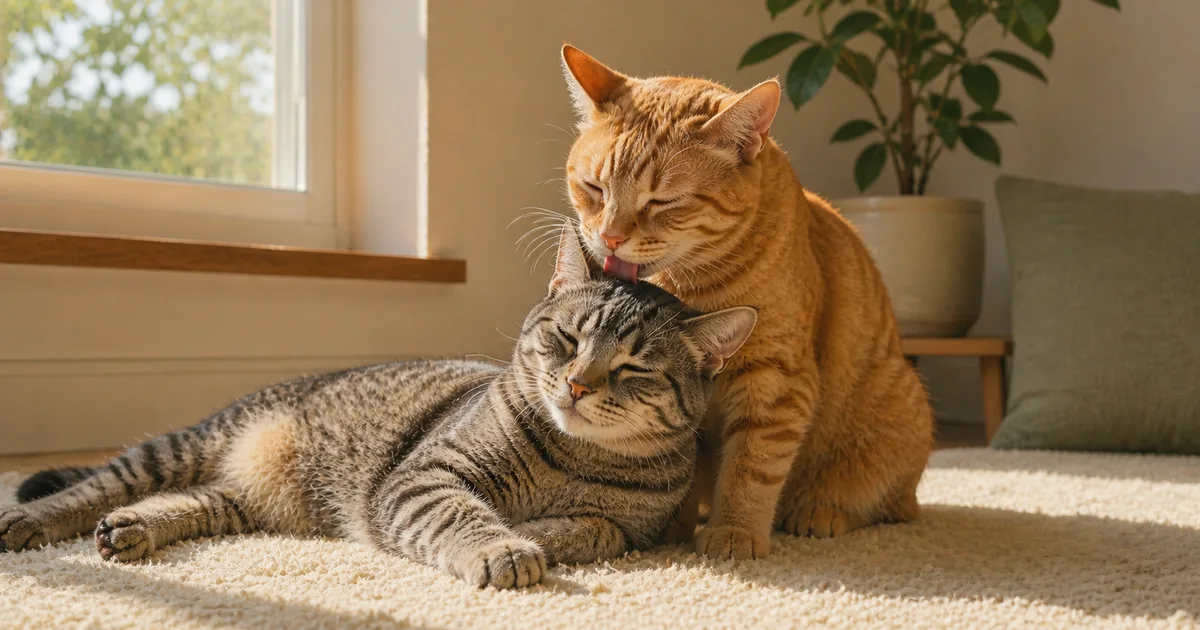
A surprising fraction of multi-cat households are running on lower-grade chronic conflict the owners don’t recognise. The cats aren’t fighting visibly — they’re using different rooms at different times, eating in shifts, posturing across doorways, and quietly modulating their lives around each other’s presence. That’s not a peaceful coexistence; that’s two stressed animals doing the work to avoid escalation.
The good news: the science of cat-cat compatibility is well-developed. The AAFP/ISFM 5 Pillars framework + a structured introduction protocol + thoughtful resource design fix most multi-cat tension. This guide covers what feline vets and behaviourists actually recommend.
Why cats don’t naturally cohabit
Domestic cats descended from Felis silvestris lybica, the African wildcat — a solitary territorial species. Cats have secondary sociality: they can live in groups when resources are abundant (the cat colonies around fishing villages, cats in barns) but their default ecology is solitary territory-holding. We forget this when we adopt a second cat into a 700-square-foot apartment and expect them to "be friends."
The good multi-cat household design works with this biology. The bad one ignores it.
The introduction protocol — 2-6 weeks done properly
Cat-cat first impressions are durable. A botched introduction can produce 6+ months of unwinding work. The standard protocol — backed by ISFM, ASPCA, and most feline behaviourists:
Week 1: complete separation + scent swap
Resident cat in their normal home; new cat in a single closed room with all their resources (food, water, litter, bed, toys). The cats can hear each other but never see each other. Daily: take a soft towel, rub it on the new cat’s cheeks (collecting facial pheromones), place it near the resident cat’s resting spot. Repeat in reverse. The cats become familiar with each other’s scent before any visual contact.
Week 2: feeding through a closed door
Place each cat’s food bowl on opposite sides of the closed door separating them. Both cats associate the other cat’s smell with food (a positive event). Start with bowls a few feet from the door; move incrementally closer over the week. By end of week 2, they should be eating directly on either side of the door without anxiety.
Week 3: visual contact through a barrier
Use a baby gate (or a cracked door) to allow visual contact while preventing physical access. Brief sessions (10-30 minutes) with both cats getting treats / play during the interaction. Watch for body language: ears forward + relaxed bodies = good; ears flat + stiff bodies + low growling = back off, return to closed-door work.
Week 4+: supervised co-presence
Once cats are calm with visual contact, allow brief supervised free-roaming time. Have a thick blanket or pillow ready to interrupt any tension. Keep sessions short initially. Gradually extend.
Skittish cats (Russian Blue, anxious rescues, Skittish-Sensitive archetype generally) can need 2-3 months for the full protocol. Skipping phases is the single biggest cause of failed multi-cat households.
Resource design — the AAFP 5 Pillars in multi-cat form
The 5 Pillars framework you see in single-cat advice gets significantly more important with multiple cats. The N+1 rule comes from this: one resource per cat plus one extra, in different physical locations.
Litter (most critical)
Two cats = three litter boxes, in three different rooms / floors. NOT three boxes lined up in one bathroom — that’s one location to a cat, regardless of box count. Cats often refuse to use a box another cat is currently using or has recently used; without redundancy you get litter-box avoidance and inappropriate elimination, which is the #1 reason cats end up surrendered to shelters.
Food + water (separated)
Multiple food stations (N+1) in different rooms. Multiple water stations (N+1) ideally not adjacent to food (cats prefer water away from prey/food in their evolutionary mental model). One station per cat means the dominant cat blocks the other; resource guarding shapes the household quietly.
Vertical territory
Two cats in a flat territory create a 2D conflict zone. Add vertical complexity (cat trees, cleared shelves, window perches, top-of-bookshelf access) and conflict drops dramatically — cats can pass each other in 3D space, the lower-status cat can escape upward, both can monitor the room without competing for the same square footage.
Hiding spots
Each cat needs at least 2-3 covered hides in different rooms — places they can disappear from each other’s sight. The lower-status cat especially needs certain retreat options at all times.
Reading whether your cats actually like each other
Don’t mistake "tolerating" for "bonded." The hierarchy of multi-cat relationship quality, weakest to strongest:
- Active conflict — visible fights, hissing, blocked spaces. Worst. Needs intervention now.
- Active avoidance — cats use different rooms / different times. Lower-grade chronic stress; both cats are managing the situation. Owners often miss this — it looks "peaceful."
- Tolerance — cats coexist in the same rooms without conflict but never affiliate. Acceptable; most multi-cat households at this level.
- Affiliation — tail-up greetings between the cats, allorubbing, occasional shared sleeping spots. Genuinely friendly.
- Bonded — allogrooming (one cat licking the other), regular shared sleeping, tail-wrap, nose touches at greeting. The strongest signal a multi-cat relationship is genuinely good.
If you’ve never seen allogrooming or tail-wrap between your cats and they’ve lived together a year, you’re probably at "tolerance" — the household is stable but not bonded. That’s fine; you don’t need affection between cats for a healthy home. But understand that "they don’t fight" is the lower bar, not the higher one.
The personality compatibility lens
Litchfield Five framework predicts multi-cat outcomes well. The single biggest predictor: activity level + dominance match. Two high-dominance cats will compete for territory indefinitely. Two low-activity calm cats will coexist quietly. A high-spontaneity Hunter-Athlete paired with a Skittish-Sensitive cat is a recipe for chronic stress — the energetic cat’s play-attempts read as harassment to the anxious one.
If you’re considering adding a second cat, the most useful question is: "What’s a good day for my current cat? Will the new cat have a similar good day?" If yes, compatibility is likely. If their good days look incompatible, even perfect introductions won’t produce a relaxed household.
What to do when it’s gone wrong
If you’re reading this with two cats already in chronic tension, the playbook:
- Re-introduce. Yes, even after months together. Treat it as a from-scratch introduction with the 4-week protocol. This often works because it lets the cats reset their expectations.
- Audit the resource map. Walk the home with a notebook; count litter boxes, food stations, water stations, hides, vertical territory. Map shortest paths each cat takes from sleeping spots to litter to food. Where they cross is where conflict happens.
- Add Feliway Multicat. Different formulation from the standard Feliway diffuser; targets cat-cat tension specifically. 30-day trial.
- Consult a vet behaviourist. Real fighting (not play) at week 12+ post-introduction is a behaviourist case. Some pairs respond to fluoxetine in addition to environmental changes.
- Accept that some pairings don’t work. ~5-10% of cat pairings don’t reach even tolerance regardless of effort. If you’re a year in and one cat is hiding 16 hours a day, the kindest answer for both cats may be to rehome one to a single-cat household.
What this changes
The biggest mistake multi-cat owners make is treating their cats as a single household unit instead of two separate territorial animals sharing space. The framework here — proper introduction, N+1 resource separation, vertical territory, personality compatibility, body-language reading — addresses every level of the problem at once.
Most multi-cat tension is a design problem, not a personality problem. Fix the design and most cats settle.
Frequently asked questions
My two cats "tolerate" each other but never sleep together. Is that fine?
Tolerating is the lower bar — most multi-cat households are at this level and that’s acceptable. The higher bar is allogrooming + sharing sleeping spots + tail-up greetings. If your cats avoid actively conflicting, you have a stable household. If they actively avoid each other (using different rooms, eating at different times to avoid presence), that’s lower-grade chronic stress worth addressing through resource redesign.
How long does a proper cat-cat introduction take?
Two to six weeks for most pairings. Faster than that means you skipped a phase and the relationship will likely have residual tension. The standard sequence: week 1 separation + scent swap, week 2 visual contact through a barrier, week 3 supervised brief co-presence, week 4 longer co-presence. Skittish cats (Russian Blue, anxious rescues) can need 2-3 months. Forcing it is the single biggest cause of failed multi-cat households.
Do cats "need a friend" if I’m at work all day?
Highly individual. Cats from breeds bred for human-attachment (Sphynx, Tonkinese, Burmese, Velcro-Cat archetypes generally) genuinely suffer from prolonged solo time and benefit from a feline companion. Cats from independent / cool-observer breeds (British Shorthair, many DSH) often prefer to be the only cat. Litchfield Five outgoingness scores predict this — high outgoingness + low dominance = good single-cat-to-multi-cat conversion candidate; low outgoingness OR high dominance = leave them solo.
My older cat hates the new kitten. Will it ever get better?
Usually yes, but slowly — 3-6 months of patience plus active environmental design. Older cats find rambunctious kitten energy genuinely stressful; the kitten’s play-attempts read as harassment. Provide elevated escape routes (shelves, cat-trees) where the older cat can be high and untouchable. Use baby gates to separate during high-energy periods. Most older cats accept a kitten over time as the kitten matures and calms down at 12-18 months. If actual fighting (not play) is occurring weekly past month 3, consult a vet behaviourist.
Triage your cat in under 60 seconds
Not sure if this is an emergency? CatMD runs feline-specific triage on symptoms or photos and returns a 0–99 health score with urgency tier, differentials, and a vet-ready summary.
Get the app