5 Pillars of a Happy Indoor Cat
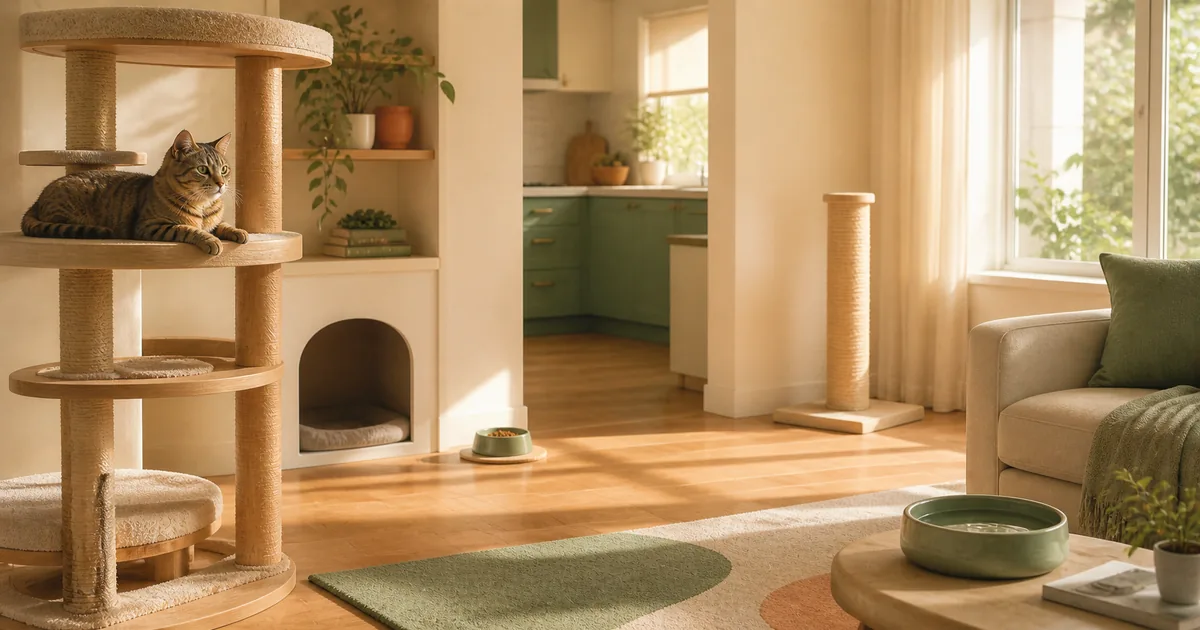
An indoor cat’s welfare isn’t about love alone — it’s about environmental design. Cats evolved to spend their lives navigating a 100-acre territory full of vertical space, hiding spots, prey, and choices. We move them indoors and ask them to be happy in 700 square feet. They can be — but only when we design the space to give back what the outdoors took away. (If you’re raising a kitten right now, the environment you create during the first sixteen weeks of kitten development will shape who they become — design accordingly.)
The American Association of Feline Practitioners (AAFP) and International Society of Feline Medicine (ISFM) jointly published the 5 Pillars of a Healthy Feline Environment in 2013, and it’s been the welfare gold standard ever since. Every feline-friendly veterinary practice in the world is built around these five needs. This guide walks through each pillar, what it means in practice, and how to audit your home in 15 minutes.
Pillar 1 — Provide a safe place
Cats need refuge. A safe place is somewhere a cat can hide, feel concealed, and not be reachable by other animals or people. Multiple safe places per cat, spread around the home.
Practical: covered cat beds, igloo-style hides, cardboard boxes (free and effective), the underside of a sofa, the top of a closet. Critically, the safe place should be off the floor in at least one location — elevated hides feel safer to cats than ground-level ones because they can monitor the room from above.
Test: when something disrupts your cat (vacuum, doorbell, guests), where do they go? If the answer is "under the bed every time," they have one safe place — they need at least two more in different rooms.
Pillar 2 — Multiple, separated key resources
Resources are food, water, litter, scratching posts, sleeping spots, and toys. Cats need multiple of each, in separate locations. The classic mistake is a single "cat zone" — food bowl, water bowl, and litter all stacked in one corner of the kitchen — which forces resource encounters and creates chronic low-grade tension.
The N+1 rule: one resource per cat, plus one extra. Two cats = three food stations, three water bowls, three litter boxes. Each in a different location.
Why it matters: in nature, cats keep food, water, and elimination separate by walking distances. Forcing them into proximity causes low-level chronic stress, bullying at shared bowls, litter-box avoidance, and urinary issues (feline idiopathic cystitis is stress-driven).
Audit: map your home. For each resource, count locations. If there are two cats and only one litter location — even with three boxes lined up there — that’s a Pillar 2 violation. Spread them.
Pillar 3 — Opportunity for play and predatory behaviour
Cats are obligate predators with a deeply wired hunt-stalk-pounce-bite-eat sequence. Indoor cats with no outlet for that sequence experience the same low-grade frustration as a working dog with no work. The fix isn’t toys lying on the floor — it’s structured play that completes the predatory sequence.
Wand-toy protocol: 5–10 minutes, 1–2 sessions a day. Move the toy like prey — dart, hide, freeze, scurry. Let the cat catch it at the end. Follow immediately with a small meal. This mimics the natural cycle (hunt → eat → groom → sleep) and produces a satisfied cat.
Food puzzles: dispense part of the daily ration through puzzle feeders, lick mats, or hidden bowls around the home. Cats should work for some of their food.
Toy rotation: keep three to five toys out at any time, rotate them weekly. Novelty is what triggers play; "old" toys lose interest fast.
Pillar 4 — Positive, consistent, predictable human-cat social interaction
Cats are not solitary — most are highly social with bonded humans — but their social rules are different from dogs’. They prefer interactions that are brief, predictable, and on their terms. The biggest welfare violation here is humans pushing affection on cats who don’t want it.
Let the cat initiate. When the cat approaches and rubs, that’s an invitation. When the cat walks away mid-pet, that’s the end of the session. Honour both signals consistently and the cat will trust you more.
Routine matters. Cats thrive on schedule. Feed at the same times, play at the same times, and the cat’s nervous system relaxes around the predictability.
Don’t over-pet. Most cats prefer cheek and chin scratches over body strokes. Most don’t enjoy belly rubs even when they show belly. Read the tail-tip twitch (see our body-language guide) for the signal that they’ve had enough.
Pillar 5 — Respect for the cat’s sense of smell
Cats live in a scent-first world. Their olfactory system is far more sensitive than ours, and their territory is largely defined by scent markers. Two practical implications:
Don’t over-clean cat-marked areas. When your cat cheek-rubs furniture, doorways, or your legs, they’re depositing facial pheromones that mark the space as safe. Aggressively cleaning these areas with strong chemicals erases that safety signal. Use cat-safe enzymatic cleaners only where needed (urine accidents); leave cheek-rub spots alone.
Avoid strong scents in cat areas. Plug-in air fresheners, scented candles near litter boxes, perfume sprays, and scented detergents on cat bedding all overwhelm the cat’s scent map of home. Some essential oils (tea tree, citrus, eucalyptus) are also toxic to cats. Keep cat areas scent-neutral.
Use synthetic feline pheromone (Feliway). The synthetic version of the cheek-rub pheromone, released via plug-in diffuser, can lower stress in cats during introductions, moves, and inter-cat tension. Evidence is moderate but the downside is zero — worth a 30-day trial.
The 15-minute home audit
Walk your home with a notebook. For each pillar, note compliance:
- Safe places: count covered hides per cat. Are at least two per cat in different rooms? Is at least one elevated?
- Resources: map food, water, litter, scratching posts. N+1 of each? In separate locations (not just stacked)?
- Play: when did you last do a structured wand-toy session? If "weeks ago," that’s the gap.
- Interaction: are interactions cat-initiated or human-initiated? Does your cat ever walk away mid-session and you keep going?
- Smell: any plug-in air fresheners, scented candles, scented litter, or strong cleaners in the cat’s zones? If yes, that’s the friction.
Most homes that "have a stressed cat" have two or three pillar gaps. Closing them takes a weekend of furniture rearranging and £50–100 of new resources. The before/after in the cat’s body language and behaviour is often dramatic.
What this changes
The 5 Pillars framework reframes welfare from "do they have food, water, and a clean litter box" to "is the environment designed for a cat to be a cat." When the answer is yes, the standard markers — friendly behaviour, regular routines, low aggression, no inappropriate elimination, healthy weight — follow naturally. When the answer is no, no amount of love compensates.
You don’t have to renovate the house. Most pillar gaps close with small, deliberate changes — a second litter box upstairs, a cat tree by a window, 10 minutes of wand-toy a day, dropping the plug-in air freshener. Five small interventions, one weekend, and the cat’s welfare profile shifts from "coping" to "thriving."
Frequently asked questions
How many litter boxes do I actually need?
The AAFP/ISFM standard is N+1 — one box per cat plus one. Two cats = three boxes. Three cats = four boxes. Crucially, the boxes need to be in DIFFERENT locations — three boxes lined up in one bathroom is one location to a cat, not three. Spread them across rooms and ideally floors. Litter-box avoidance and inter-cat tension drop dramatically when this rule is followed.
My cat doesn’t play with toys. Are they boring or am I doing it wrong?
Almost always: the toy or technique is wrong. Cats don’t play with toys that don’t move; they don’t play with toys that move predictably; and they lose interest in toys they’ve seen all day. The fix: wand toys (mimic prey), short sessions of 5–10 minutes, end with the cat catching the toy and an immediate small meal (mimics the natural hunt-eat-groom-sleep cycle), and rotate toys weekly so they stay novel.
How do I introduce a new cat without weeks of fighting?
Slow, structured, scent-first. Week 1: keep the new cat in a separate room with all its resources; swap bedding/towels between rooms daily so each cat gets used to the other’s scent without seeing them. Week 2: feed both cats on opposite sides of a closed door so they associate each other’s smell with food. Week 3: visual contact through a baby gate or cracked door, brief sessions. Week 4: supervised free-roaming, starting with very short windows. Most introductions take 2–6 weeks; rushing it is the single biggest cause of long-term inter-cat tension.
Do indoor cats really need vertical territory?
Yes — it’s one of the most under-implemented welfare needs. Cats are arboreal-leaning predators; height is where they feel safe and where they monitor their territory from. Two elevated spots per cat in different rooms is the minimum. Cat trees, window perches, cleared shelving, even the top of a bookshelf all count. Vertical territory reduces inter-cat tension in multi-cat homes more than almost any other intervention.
What’s the simplest single change with the biggest impact?
Wand-toy play, 10 minutes a day, before the evening meal. It hits three pillars at once — play (Pillar 3), positive interaction (Pillar 4), and routine (which feeds into emotional security). It addresses zoomies, mild destructive behaviour, mild stress, and bonds the cat to you. It costs nothing and fits into any schedule. If you do nothing else from this article, do this.
Triage your cat in under 60 seconds
Not sure if this is an emergency? CatMD runs feline-specific triage on symptoms or photos and returns a 0–99 health score with urgency tier, differentials, and a vet-ready summary.
Get the app