Why Cats Meow at Humans (and Almost Never at Other Adult Cats)
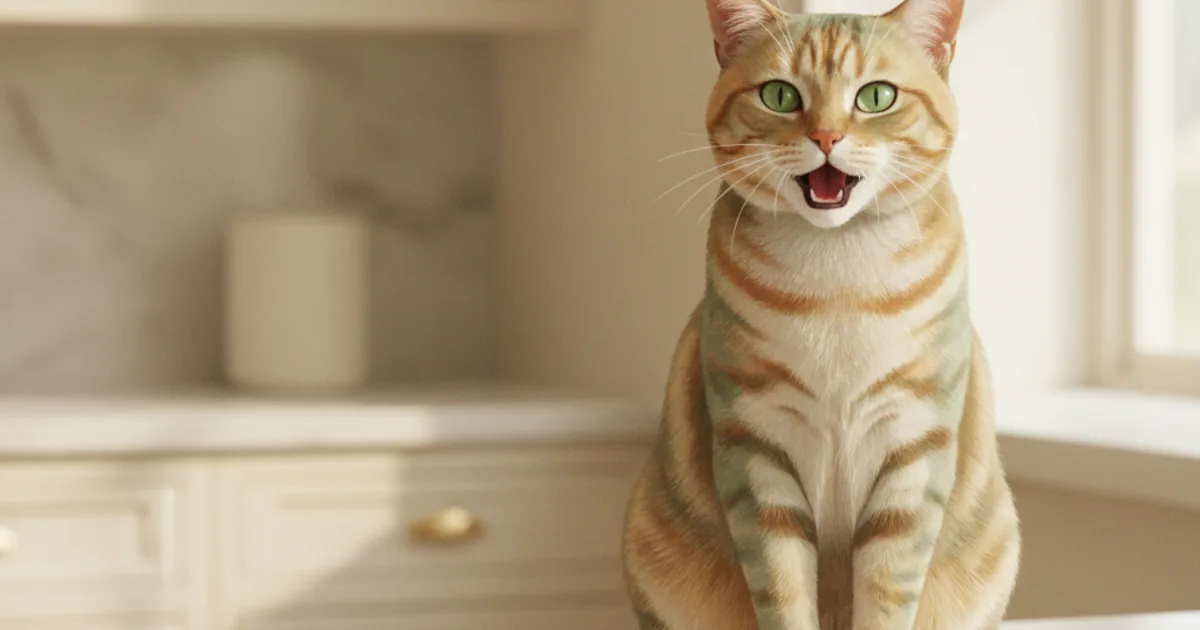
Adult cats meow at humans constantly. Adult cats almost never meow at each other. This is one of the most surprising facts in domestic-cat behaviour, and once you know it, you start seeing your relationship with your cat differently — the meows you hear all day are a vocabulary your cat developed specifically for you.
Cat communication in the wild is dominated by body language and scent. Tail position, ear rotation, eye contact, scent-marking on objects and other cats — these carry the bulk of information between adult feline conspecifics. The meow is, evolutionarily speaking, mostly absent from this picture. Where the meow DOES appear in feral cats is in two narrow contexts: kittens calling to their mothers, and mating calls during oestrus. Adult cats interacting with adult cats? Largely silent, with body language doing the work.
So why do domestic cats meow at humans all day?
The leading hypothesis, supported by decades of feline-behaviour research (notably John Bradshaw's work at the University of Bristol's Anthrozoology Institute), is that domestic cats retained and expanded the meow because humans respond to it. The meow that worked on the mother — "I want food", "I'm cold", "come here" — also worked on the human. Across thousands of years of domestication (cats self-domesticated around grain stores roughly 9,500 years ago), the meow became the primary cross-species communication channel.
What's remarkable about this is the direction of adaptation. Most domesticated species learn to read HUMAN signals — dogs follow human pointing gestures, horses respond to human posture, working animals attend to human emotional cues. Cats did the opposite: they expanded their OWN signalling system to manipulate humans, who respond to it more or less unconsciously.
Studies have confirmed that humans are particularly responsive to cat meows in a frequency range similar to a human infant's cry — and that some domestic cats appear to have adjusted their meow frequencies into this range over generations. McComb et al published a 2009 study in Current Biology documenting "solicitation purrs" with embedded high-frequency components that humans rate as more urgent and harder to ignore than ordinary purrs.
What this means for your specific cat
If you've lived with the same cat for more than a few months, that cat has built a personalised meow vocabulary for you. Not for cats in general; for you specifically. The "feed me" meow is different from the "let me out" meow because you (probably without realising it) trained your cat by responding differently to different sounds. Most owners can identify three to five distinct meows from their own cat by month six of cohabitation — even though they couldn't identify any meows from a friend's cat at all.
This is why generic meow-translation apps (the audio-only kind) hit a ceiling fast. Every cat's vocabulary is bespoke to its household. A meow that means "feed me" in your house might mean "open the bathroom door" in your friend's house, depending on what each owner has historically responded to. The classification is the same — both are demand vocalisations — but the SPECIFIC intent only makes sense in context. That's why the next generation of multimodal meow translators use per-cat memory in addition to audio: the same meow means different things for different cats.
The eight or so sounds your cat actually uses
Even though every cat has a personalised vocabulary, the underlying SOUND inventory is small and consistent. The full vocabulary is documented in the existing guide on how to read your cat's vocalisations. The short version:
- Meow — the all-purpose request, almost exclusively human-directed
- Trill / chirp — friendly greeting, originally a mother-to-kitten call
- Purr — bidirectional self-soothing (NOT just "happy" — cats purr in distress too)
- Growl — warning, exhale-dominant
- Hiss — defensive, sharp forced exhale
- Yowl — long mournful call, distress or mating
- Chatter — frustrated predatory state, almost exclusively at unreachable prey
- Scream — pain or mating, vet emergency in non-breeding contexts
The interesting thing is that cats vary enormously in how often they use which sounds, but they don't typically invent NEW sounds. Your cat's personality (covered in the Feline Five framework) shapes which of these eight your cat reaches for and how often. A Confident-Communicator archetype meows constantly; a Cool-Observer might meow twice a day. Same vocabulary; very different deployment.
Why kittens are the exception
Kittens meow at everything — at their mothers, at their littermates, at humans, at inanimate objects. The meow is one of the first vocalisations they develop (typically by week 2-3) and it's their primary tool for getting needs met from a mother who can't see them clearly in low light or hear them over other litter sounds.
As kittens mature into adults, the meow drops out of cat-cat communication around weeks 8-12. The mother stops responding to most meows; the kittens stop emitting them at each other. By the time a kitten is rehomed at 12-14 weeks (the modern best-practice adoption window), they're emitting meows mostly toward humans, who reinforce the behaviour.
This is why kittens often seem extraordinarily vocal in their first weeks at a new home — they're running their full kitten-meow inventory at you, expecting maternal-style responses. Most settle into a more adult vocal pattern by month 6.
The senior-cat exception worth flagging
If a previously quiet adult cat suddenly starts meowing or yowling more, particularly at night, that's a flag worth taking to a vet — not "just aging." Three medical causes account for most cases:
- Hyperthyroidism — early phase causes restlessness, increased appetite, and night-time vocalisation. Common in cats over 10. Detected by a simple T4 blood test, treatable with daily medication or radioactive iodine therapy.
- Hypertension — high blood pressure in cats is often secondary to kidney disease or hyperthyroidism. The vocalisation symptom often appears alongside sudden visual disorientation (retinal detachment from elevated pressure). Treatable with daily medication.
- Feline cognitive dysfunction (FCD) — the cat dementia equivalent. Disorientation, lost diurnal rhythm, getting "stuck" in corners, vocalising at 3 AM in an empty room. Manageable with environmental adjustments + sometimes medication; not curable but slowable.
None of these are "the cat is being demanding." They're medical changes that happen to surface as vocalisation. The vocalisation is the symptom; the underlying condition is the diagnosis. A senior wellness exam with bloodwork and blood pressure check is the standard workup.
What this changes day-to-day
Once you understand that the meows you hear are specifically for you, two things shift. First, you stop dismissing your cat's vocabulary as random noise — every meow is an attempt to communicate something they've learned will get a response. Second, you start paying attention to BASELINE shifts: a normally vocal cat going quiet, or a quiet cat suddenly yowling at night, becomes a clear signal worth investigating rather than ambient sound.
The relationship implication is bigger. Your cat developed a vocal vocabulary FOR YOU because you, specifically, are the one who responded. That's not nothing. It's one of the few examples in the animal world where the non-human species did the cross-species communication work, not the other way around. The cat in your house has, in some sense, learned a language to talk to you.
Frequently asked questions
Do cats meow at each other?
Adult cats almost never meow at each other. Cat-to-cat communication in the wild is dominated by body language and scent. Kittens meow at their mothers (and mothers respond), but as cats mature the meow drops out of cat-cat communication. The exception is humans — domestic cats appear to have RETAINED and EXPANDED the meow specifically because humans respond to it. If you have multiple cats and they meow at each other, what you're usually seeing is a kitten-relationship dynamic that didn't fully mature, or one cat treating the other like a litter-mate it grew up with.
Why is my cat suddenly meowing more than usual?
Three main causes worth screening, especially in older cats: hyperthyroidism (overactive thyroid causes restlessness + nighttime activity + vocalisation), hypertension (sometimes secondary to retinal detachment causing sudden disorientation), and feline cognitive dysfunction (the cat dementia equivalent, with disrupted day-night rhythm). All three are treatable. A senior wellness exam with bloodwork + blood pressure check usually identifies which. If your cat is younger and the increase is recent, look for environmental triggers — a new pet, a moved feeding station, a missed schedule.
Why is my cat not meowing — should I be worried?
Probably not. Cats vocalise toward humans much less than humans assume they should. A confident, well-adjusted cat with predictable feeding times and no unmet needs may meow only a few times a day. Vocal frequency is largely individual + breed-driven (Siamese / Tonkinese / Burmese are loud; British Shorthair / Russian Blue / Persian are quiet). Concern only if the cat WAS vocal and now isn't — a vocal-baseline drop in a senior cat warrants a check-up (possible hearing loss, neurological change, or systemic illness).
Can cats understand human speech?
Cats recognise their own name (research by Saito et al, Nature Scientific Reports 2019, demonstrated this in a controlled experiment) and the voices of household members vs strangers. They appear to understand a small functional vocabulary of frequently-used phrases — "dinner", "down", their name, the can-opening sound — through associative learning. They do not understand syntax or arbitrary new sentences. Tone matters more than words: cats respond strongly to high-pitched warm tones (similar to mother-to-kitten "queening" calls) and pull back from sharp angry tones. The "talking to your cat" effect is real but bounded.
Is my cat trying to manipulate me when they meow?
Effectively, yes — but it's not malicious manipulation, it's learned communication. Domestic cats developed an expanded meow repertoire across thousands of years of co-evolution because the meows that produced human responses (food, attention, door-opening) were reinforced. Your specific cat learned, over the months you've known them, which meows get which response from you. The "feed me" meow is different from the "let me out" meow because you trained your cat by responding differently. This is one of the few examples of cross-species communication where a non-human species adapted to a human one rather than the reverse.
Triage your cat in under 60 seconds
Not sure if this is an emergency? CatMD runs feline-specific triage on symptoms or photos and returns a 0–99 health score with urgency tier, differentials, and a vet-ready summary.
Get the app