Why Does My Cat Meow at 3 AM? How to Sleep Again
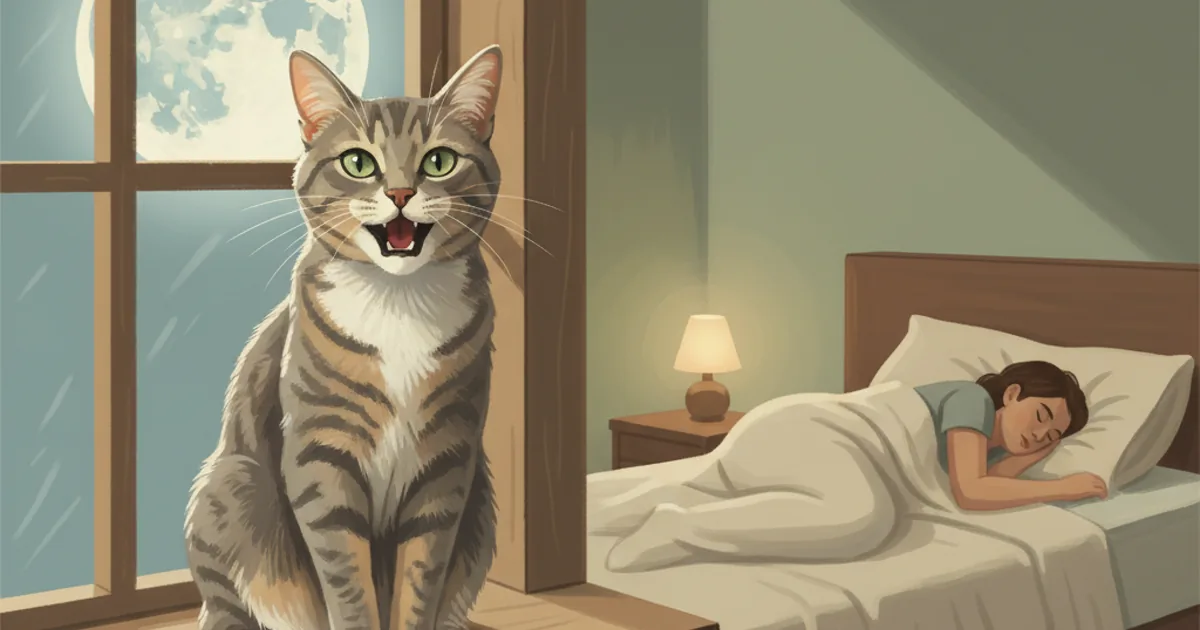
Your cat sits in the hallway at 3:14 AM and lets out a single long meow. You ignore it. They do it again at 3:17. By 3:23 you're awake, you've thrown a pillow at the door, and your cat is still meowing.
This is one of the most common complaints in feline behaviour, and it almost always has a recognisable cause. The seven main reasons cats vocalise at night are different enough that the right response depends on which one you're dealing with. A solution that works for a bored young adult cat will not help a senior with cognitive dysfunction, and vice versa.
This guide walks through the seven causes, how to tell them apart, and the specific response that addresses each one.
Why cats are wired to be active at night
Cats are crepuscular — naturally most active around dawn and dusk. In the wild, this is when their main prey (small rodents) are most active. The 3-5 AM stretch is the biological ramp-up to the dawn hunting period.
An indoor cat with no real prey to chase still has this hardware. If their predatory drive isn't burned off during the day or evening, it shows up at 3 AM as restlessness, vocalisation, and the kind of zoomies that knock over a glass of water on the way to your face.
This is the baseline. Some nighttime activity is normal. The question is when it crosses into a problem, and what's causing it.
Cause 1 — Boredom and unused predatory energy
The most common cause in indoor cats under 10. Cat had a quiet day, didn't get enough play, has stored hunting energy with nowhere to go. The 3 AM wake-up call is the cat asking for stimulation.
The fix: a structured evening play-eat-sleep sequence that mimics the natural hunt-eat-groom-sleep cycle:
- 9:00-9:20 PM: 15-20 minutes of intense wand-toy play. Make the toy behave like prey — pauses, sudden movements, hide-and-reappear. End the session with a "successful catch."
- 9:25 PM: feed the cat a small wet-food meal.
- Lights out.
This sequence triggers the natural post-meal grooming and sleep response in cats. Two to four weeks of consistency and most healthy adult cats shift their sleep cycle to better align with yours.
Cause 2 — Learned reinforcement (the most fixable cause)
If you've ever gotten out of bed at 3 AM to feed your cat, open a door, or just to yell at them to stop meowing, the cat has learned that 3 AM meowing produces a human response. From the cat's point of view, this is excellent news. They will repeat the behaviour.
This is why the standard advice is to ignore nighttime meowing completely. Any response — feeding, talking, opening the bedroom door, even a frustrated "shut up!" — counts as reinforcement. The cat does not care whether the reaction is positive or negative; they care that the meowing produced an outcome.
The fix: commit to a hard zero-response policy for 2-3 weeks. The behaviour will get worse for the first 3-7 days (this is called an "extinction burst" — the cat tries harder before giving up). After the burst, the meowing reliably decreases. The single most common reason this fails: a partner or roommate cracks and responds once, which resets the entire learning cycle.
Combine zero-response with the evening play-eat sequence above and you've addressed the two most common causes simultaneously.
Cause 3 — Hunger or thirst (sometimes legitimate)
Cats who are fed twice a day with a large gap between dinner and breakfast can genuinely run out of food by 3 AM. This is more about how the human stomach works than the cat's — cats are designed to eat 10-15 small meals a day, not two large ones.
The fix: an automatic timed feeder set to dispense a small portion of dry food around 4-5 AM. The food arrives on a timer, not in response to meowing. Make sure water is fresh and accessible overnight too — multiple bowls in different rooms.
Free-feeding works for some cats but tends to drive weight gain in others, so the timed feeder is usually the better compromise.
Cause 4 — Senior cognitive dysfunction (cats over 10)
One of the most common new-onset nighttime vocalisation causes in older cats, and one of the most missed. Feline cognitive dysfunction syndrome (CDS) — sometimes called "feline Alzheimer's" — affects an estimated 28% of cats aged 11-14 and over 50% of cats aged 15+.
The pattern: a cat who previously slept through the night suddenly wakes up at 2-3 AM and yowls — loud, prolonged, sometimes anxious-sounding. They may seem disoriented, stand in the middle of a room, stare at walls, or vocalise in unusual locations (the bottom of the stairs, an empty hallway). Sometimes they don't immediately recognise familiar people or environments when they wake.
CDS is a vet diagnosis. There's no single test — it's a clinical assessment that rules out the other causes (hyperthyroidism, hypertension, pain, sensory decline) and looks for the cognitive pattern. The good news: it's manageable. Diet changes (omega-3, antioxidants, medium-chain triglycerides), environmental enrichment, night lights, and in some cases medication (selegiline, gabapentin for anxiety) can reduce symptoms.
If your cat is over 10 and the nighttime meowing is new, this is a vet visit, not a training problem. See our guide on senior cat care after age 10 for what to track and what to bring to the vet.
Cause 5 — Hyperthyroidism (cats over 7)
Hyperthyroidism is one of the most common feline endocrine diseases, affecting roughly 10% of cats over 10. It's an overactive thyroid that drives up metabolism and produces a recognisable cluster of symptoms:
- Weight loss despite a strong (sometimes ravenous) appetite.
- Increased thirst and urination.
- Restlessness, hyperactivity, increased vocalisation — including at night.
- Unkempt coat.
Cats with hyperthyroidism often wake up at night and pace, yowl, demand food, then eat normally but keep losing weight. The vocalisation is restless rather than confused, which helps distinguish it from CDS.
This is diagnosed with a blood test (T4 level) and is highly treatable — medication, radioactive iodine therapy, surgery, or a prescription diet are all options. Untreated, hyperthyroidism causes heart, kidney, and blood-pressure damage. Treated, cats often return to normal vocalisation within weeks.
If your cat is over 7, vocalising at night, and you've noticed any weight loss, get a thyroid panel. This is one of the most common things vets find when an owner brings in a cat for "won't stop meowing at night."
Cause 6 — Pain (any age, often arthritis)
Cats hide pain extremely well (see how cats hide pain), but pain often surfaces at night when the cat is no longer distracted by daytime activity. Arthritis — surprisingly common in cats over 7 — can cause restless pacing and vocalisation at night, especially in cooler months when stiffness is worse.
Other pain causes: dental disease (especially resorptive lesions, which are common and very painful), urinary tract issues (cats with FIC may vocalise when straining or urinating), abdominal discomfort.
If the nighttime meowing has a "complaining" tone, is paired with reduced jumping (see cat not jumping), reduced grooming (see cat grooming less), or any litter box changes, pain is on the differential. A senior cat workup including a Feline Grimace Scale pain check is reasonable.
Cause 7 — Closed doors and territorial frustration
If you close your bedroom door at night and your cat sits outside meowing, the cause is straightforward: the cat wants access. They may want to be near you, want to use the bedroom litter box, want to look out the bedroom window, or simply object to being excluded from territory.
The fix: if practical, leave the bedroom door open. If you have allergies or partners who can't sleep with a cat in the bed, install a baby gate that allows visual access but not entry. Many cats are satisfied by being able to see you. If neither works, ensure the cat has somewhere appealing to sleep on the other side of the door — a heated bed, a window perch with a view, an item of your clothing.
How to figure out which cause is yours
| Pattern | Most likely cause | Right next step |
|---|---|---|
| Young adult cat, indoor, energetic, meowing started recently | Boredom + learned reinforcement | Evening play-eat sequence + zero-response policy |
| Cat over 10, new-onset loud yowling, sometimes seems disoriented | Cognitive dysfunction | Vet workup — clinical diagnosis |
| Cat over 7, restless, losing weight, eating well | Hyperthyroidism | Vet workup — T4 blood test |
| Any age, paired with reduced jumping, grooming, or litter box changes | Pain | Vet workup including pain assessment |
| Lifelong pattern, worse when bedroom door closed | Territorial frustration | Open the door or install a baby gate |
| Started after a household change (new pet, move, schedule change) | Stress + adjustment | Environmental enrichment, time, possibly Feliway |
Cats over 7 with any new-onset nighttime vocalisation — even mild — are worth a vet conversation. The three biggest causes in that age group (CDS, hyperthyroidism, pain) are all treatable, and treating them is usually the difference between "manageable change" and "ongoing decline."
What about CatMD?
If you're not sure whether your cat's nighttime vocalisation is a behaviour pattern or a medical signal, CatMD's daily check-ins and triage tools are designed for exactly this kind of "I'm not sure if this is a vet visit or not" question. The app tracks weight, appetite, litter box, and behaviour over time, so a slow drift toward more vocalisation or restlessness shows up as a clear trend rather than something you have to remember.
For cats over 7, the longitudinal picture often catches the early hyperthyroidism or arthritis pattern before the owner would notice on their own. Free on Google Play — informational triage only, not veterinary advice. See the Google Play link.
Editorial note: This article is educational content, reviewed against peer-reviewed feline veterinary and behavioural sources (Merck Veterinary Manual; AAFP/AAHA Senior Care Guidelines; Cornell Feline Health Center; Bradshaw & Turner, The Domestic Cat: The Biology of its Behaviour). It is not a substitute for veterinary diagnosis or treatment. In a medical emergency, contact a licensed veterinarian immediately.
Frequently asked questions
Why does my cat meow at 3 AM specifically?
Cats are crepuscular — most active around dawn and dusk — and 3-5 AM is the natural ramp-up period before dawn. If your cat has unused predatory energy from the day, that energy peaks just before sunrise. Cats also learn that 3 AM meowing reliably gets a human response (even a frustrated one), which positively reinforces the behaviour. The combination of biological clock + learned reinforcement is why "my cat wakes me up at exactly 3 AM every night" is such a common complaint.
Is it normal for cats to yowl at night?
Some nighttime vocalisation is normal cat behaviour — a kitten or young adult cat ramping up at dawn, a cat asking to come into the bedroom, a brief check-in meow. What is not normal: persistent loud yowling, especially in cats over 10 years old, or a sudden change in nighttime vocalisation in a cat who previously slept through. Both warrant a closer look — the senior cognitive and hyperthyroidism causes below are common and treatable.
Could my cat's nighttime meowing mean they're sick?
Yes — especially if the meowing is new, increased in volume, or paired with weight loss, increased appetite, or restlessness. Two common medical causes in adult and senior cats are hyperthyroidism (overactive thyroid, often shows as increased vocalisation, weight loss despite eating well, and night-time wandering) and cognitive dysfunction (feline Alzheimer's, common in cats over 11). Pain conditions like arthritis can also cause nighttime restlessness. Sudden changes in vocalisation pattern in a cat over 7 are a vet conversation, not a behavioural training problem.
How do I stop my cat from waking me up at night?
The reliable answer is a combination of three things: (1) a 15-20 minute predatory play session with a wand toy in the evening (around 9-10 PM) followed by a meal — this mimics the natural hunt-eat-groom-sleep cycle; (2) zero response to the meowing in the moment, even negative attention (any reaction reinforces the behaviour); (3) ensuring the cat has access to food, water, litter, and a safe sleeping spot overnight so genuine need is met. The play-eat-sleep sequence works for most healthy adult cats within 2-4 weeks of consistency. Senior cats and cats with medical causes need a different approach — see the sections below.
Why does my older cat meow at night when they never used to?
New-onset nighttime vocalisation in a cat over 10 is one of the most common signs of feline cognitive dysfunction syndrome (CDS) — the cat equivalent of dementia. The cat wakes up at 3 AM, doesn't fully recognise where they are or why they're alone, and yowls. CDS can be managed (and sometimes slowed) with diet changes, environmental adjustments, and in some cases medication. Hyperthyroidism is the other common over-10 cause. Both are vet conversations — but they're treatable, not life-sentences.
Should I feed my cat in the middle of the night to stop the meowing?
Generally no. If you feed a cat in response to nighttime meowing, you teach them that meowing produces food, and the behaviour will get worse. The exception is a cat on a strict timed-feeding schedule — in that case, an automatic feeder set to dispense a small meal around 4-5 AM can interrupt the hunger-driven wake-up without making you the source. The principle is the same: the food does not arrive because of the meowing. It arrives on a timer, regardless.
When should I see a vet about nighttime meowing?
See a vet if: the cat is over 7 and the nighttime vocalisation is new; the meowing is paired with weight loss, increased thirst, increased appetite, or visible restlessness; the cat seems disoriented when they wake (staring at walls, vocalising in odd locations, not recognising you); or the meowing has changed in tone — louder, more anxious, more prolonged. Don't assume new-onset nighttime vocalisation in a senior cat is just "getting older." It usually has a treatable cause.
Triage your cat in under 60 seconds
Not sure if this is an emergency? CatMD runs feline-specific triage on symptoms or photos and returns a 0–99 health score with urgency tier, differentials, and a vet-ready summary.
Get the app