Cat Zoomies Explained: Why Cats Sprint at 3 AM
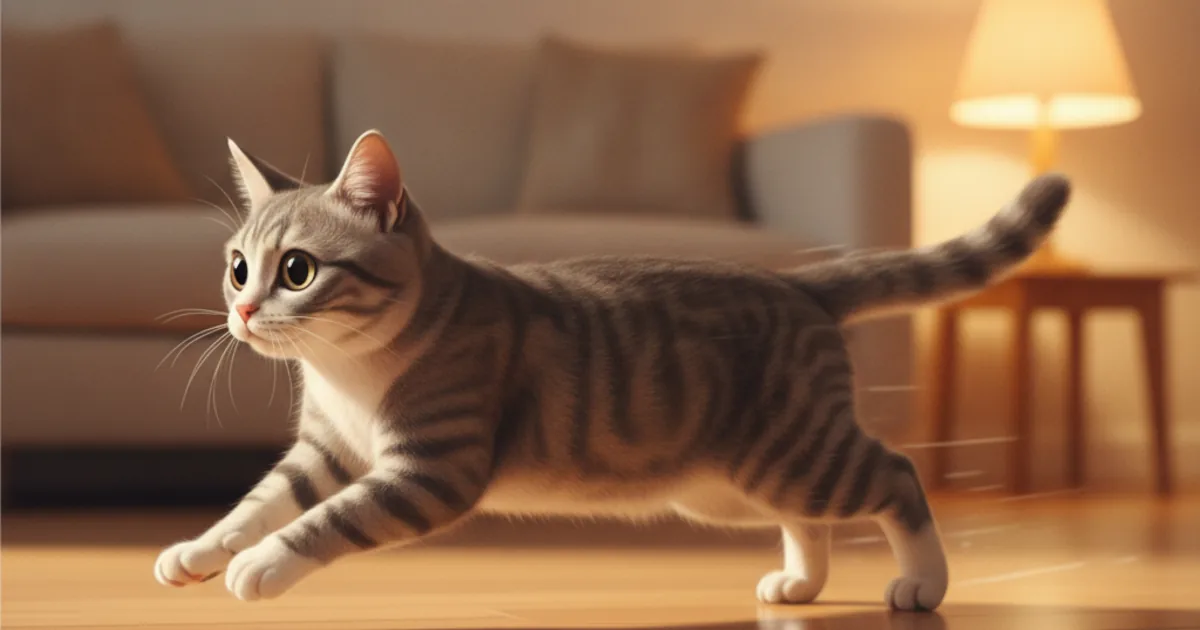
Your cat is sleeping on the couch. They open one eye. Stand up slowly. And then — for absolutely no visible reason — they explode off the couch, tear through the living room at maximum speed, bounce off the back of the chair, slide across the rug, do a 90-degree turn at the wall, and end up panting on top of the bookshelf. Total elapsed time: eleven seconds.
This is the zoomies. The veterinary behavioural term is "frenetic random activity periods" (FRAPs). They are completely normal, sometimes loud, occasionally destructive, and one of the most universal cat-owner experiences. This guide is about why they happen, when they don't need any fixing, and the rare patterns worth a vet conversation.
What zoomies actually are
FRAPs are short bursts (5-15 minutes typically, sometimes shorter) of high-intensity activity that appear unprovoked from the outside but actually have predictable triggers. The cat is fully aware of what they're doing — they're not "possessed" or having a seizure. They're discharging stored energy through their hunting-circuit motor patterns: sprint, chase, pounce, climb, repeat.
Zoomies are most common in:
- Kittens — they have enormous predatory energy and no real way to spend it. Most kittens zoomie multiple times a day.
- Young adult cats (1-5 years) — peak energy and reflexes, often paired with insufficient daily play.
- Indoor-only cats — no hunting outlet, so the energy stays bottled up until it has to come out somewhere.
- Cats fed twice a day with long gaps — hunger-related arousal triggers play behaviour.
They become rarer with age — most cats over 10 zoomie much less often, because the underlying energy isn't there. A senior cat who suddenly starts zoomie-ing again is worth paying attention to (more on that below).
The 6 most common zoomie triggers
1. Evening predator cycle (the 3-7 PM and 3-5 AM windows)
Cats are crepuscular — naturally most active at dawn and dusk. In the wild, this is when their main prey (small rodents) is most active. Indoor cats keep the schedule even when there's nothing to hunt. The 3-7 PM evening window and the 3-5 AM pre-dawn window are the two predictable zoomie peaks for healthy cats.
The 3 AM version is the one that owners notice most because it wakes them up. The fix isn't to stop the zoomies — it's to shift them earlier with a structured evening play session. See our deep-dive on cats meowing at night for the full play-eat-sleep protocol that resets the cycle.
2. Post-litter-box dashes ("poo-phoria")
Many cats sprint immediately after defecating. There are two leading theories. The biological one: defaecation stimulates the vagus nerve, producing a brief euphoric or stimulating sensation — sometimes called "poo-phoria." The evolutionary one: in the wild, the scent of fresh waste attracts predators, so the cat's instinct is to get away from the deposition site as fast as possible.
Both theories probably contribute. Either way, this kind of zoomie is harmless and doesn't need discouraging. If the dash is becoming destructive (knocking things over, jumping on humans), put a soft rug or cat tree near the litter box exit so they have somewhere to redirect the energy.
3. Post-nap discharge
Cats spend roughly 12-16 hours a day sleeping, much of it in light dozing rather than deep sleep. When they wake from a longer sleep cycle, the muscle and nervous system "recovery" can produce a brief energy spike that gets discharged through a fast sprint or play burst. This is similar to a human stretching dramatically after a nap, but with motor patterns instead of stretches.
Often paired with a stretch-and-yawn warmup followed by the sprint. Completely normal.
4. Trigger-stimulus response (something outside, something new in the house)
A bird flying past the window, a moth in the room, a new piece of furniture that smells different, the sound of treats being opened in another apartment. Any sensory stimulus that activates the hunting circuit can trigger a zoomie. The cat's body is wired so that "interesting input" rapidly becomes "physical response."
These zoomies are usually short, focused, and often end with the cat staring intently at whatever set them off. Harmless.
5. Owner-initiated play (or post-play discharge)
An intense wand-toy session leaves the cat in a high-arousal state. Even after the toy is put away, the predatory energy can take another 5-10 minutes to discharge — often through a zoomie around the room. This is one of the cleanest signs that a play session was actually doing its job: a fully-discharged cat zoomies for a few minutes, then settles deeply.
If you want zoomies to land earlier and softer, structure your play sessions to end with a "successful catch" (let the cat grab the toy and "kill" it), then feed a small meal. This mimics the hunt-eat-sequence and tends to settle the cat faster than just ending the play.
6. Anxiety or environmental stress
This is the rare but worth-noting category. Stress-driven zoomies look different from happy zoomies:
- Eyes wide, pupils dilated (vs. focused / playful expression)
- Ears flat or partially flat (vs. forward / neutral)
- Tail puffed or thrashing (vs. up / relaxed)
- Running with no clear pause-and-restart pattern (vs. sprint-pause-sprint)
- Triggered by specific stressors — a doorbell, a fight with another pet, a new person — rather than by normal cycle
If your cat zoomies in response to specific stressors with this body language, the zoomie isn't the problem — it's the symptom. Look at what's causing the stress: introducing a new pet too fast, schedule disruption, conflict with another cat in the household, environmental changes. See our guide on how to build secure attachment with your cat for the broader picture.
When zoomies are worth a vet conversation
Most zoomies are healthy. Three specific patterns are not:
New zoomies in a senior cat
A 12-year-old cat who didn't used to zoomie but suddenly is — especially if paired with weight loss, increased appetite, restlessness, or increased nighttime activity — is showing the classic profile for hyperthyroidism. The overactive thyroid drives up metabolism and produces hyperactivity and night-time zoomie behaviour in cats who would otherwise be settled. This is a simple blood test and highly treatable. See senior cat care after age 10.
Zoomies paired with disorientation
If the cat seems to lose their bearings during a zoomie — bumping into furniture they normally avoid, freezing mid-run with a confused expression, vocalising oddly — that's not normal energy discharge. In senior cats this can indicate cognitive dysfunction syndrome (CDS). In any age it can indicate a neurological issue. Worth a vet conversation.
Pain-triggered zoomies
Some cats with chronic pain (often dental, sometimes urinary tract or musculoskeletal) display sudden bursts of frantic running, sometimes paired with yowling or licking at a specific body part. The "zoomie" looks more like distress than play. If the running has a stop-and-look-at-flank quality, or the cat suddenly licks aggressively at one spot, or vocalises during the run, that's pain behaviour wearing the costume of a zoomie. Cats hide pain — see how cats hide pain for the broader signs.
How to manage zoomies (if you want to)
Most zoomies don't need management. They're a healthy cat doing healthy things. If yours are disruptive (3 AM wake-ups, breaking things, scaring guests), the principles are:
- Front-load the predatory energy. A structured wand-toy session in the early evening (9-10 PM) burns off the energy on your schedule rather than the cat's. 15-20 minutes is usually enough. End with a "catch" and a meal.
- Provide vertical territory. Cat trees, shelves, and high perches let the energy go up rather than across — less destructive, equally satisfying.
- Don't punish. Zoomies are normal behaviour. Punishing them creates anxiety without fixing anything.
- Don't reward at peak. If you laugh, chase, or pet during a zoomie, you're reinforcing it. Stay neutral. Let the cat discharge and settle on their own.
- Cat-proof the path. Move breakable objects out of the typical zoomie path. Tape down rugs that slide. Provide a soft landing zone where they typically end up.
What CatMD does with zoomie data
CatMD's Body Language reader can interpret a 6-second video of how your cat is moving, holding their ears, and using their tail — useful when you're trying to tell whether a zoomie was happy or anxious. The Daily Diary picks up on energy patterns over time and references them in the entries ("she ran the long hallway twice tonight; she always wins the corner"). The Health Rhythm view tracks activity baselines so a sudden change in zoomie frequency or intensity shows up as a real pattern, not just a vibe.
None of this is needed for normal healthy zoomies — those are just cats being cats. But if you ever want to know whether the burst pattern has shifted in a way that matters, CatMD's the surface that catches it.
Free to start. Get CatMD on iOS or Android.
Editorial note: This article is educational content, reviewed against peer-reviewed feline behavioural literature (Bradshaw & Turner, The Domestic Cat: The Biology of its Behaviour), AAFP behavioural guidelines, and Cornell Feline Health Center. It is not a substitute for veterinary diagnosis or treatment.
Frequently asked questions
What are cat zoomies?
The veterinary behavioural term is "frenetic random activity periods" (FRAPs) — short, intense bursts of high-speed running, jumping, and play, usually lasting 5-15 minutes, followed by the cat acting like nothing happened. They're completely normal in healthy cats of all ages, especially common in kittens and young adults, and most often happen in the evening, after using the litter box, or after a nap.
Why does my cat get zoomies at 3 AM?
Cats are crepuscular — biologically wired to be most active at dawn and dusk, which is when their wild prey (small rodents) is most active. The 3-5 AM window is the natural ramp-up to the dawn hunting period. Indoor cats with stored predatory energy from a quiet day burn it off in this window. If your cat's 3 AM zoomies are waking you up, the fix is a structured evening play-eat-sleep sequence — see our guide on <a href="/library/cat-meowing-at-night">cats meowing at night</a> for the full pattern.
Why do cats get zoomies after using the litter box?
Two leading theories. The first is biological: defaecation stimulates the vagus nerve, which produces a brief euphoric response — sometimes called "poo-phoria." The second is evolutionary: in the wild, the scent of fresh waste attracts predators, so the cat's instinct is to get away from the location fast. Both probably play a role. Either way, post-poop zoomies are completely normal and don't need to be discouraged.
Are cat zoomies a sign of anxiety?
Usually not. Most zoomies are normal predatory-energy discharge in healthy cats. But there are two patterns worth watching: (1) zoomies that look frantic rather than playful — cat's eyes are wide, ears flat, tail puffed, running with no clear purpose; (2) zoomies that happen in response to a specific trigger (loud noise, a new pet, a stressful situation). Both can indicate anxiety rather than pure play. If you see either pattern, look at the broader environment for stressors.
When should I worry about my cat's zoomies?
Worry signs: zoomies paired with disorientation (cat seems lost mid-run, bumps into furniture they normally avoid), zoomies in older cats who didn't used to do them (could be cognitive dysfunction or hyperthyroidism), zoomies paired with weight loss, restlessness, or increased vocalisation (classic hyperthyroidism cluster in cats over 7), or zoomies that look painful (cat suddenly stops, licks at a specific body part, or yowls during a run). Pain-related zoomies or hyperthyroid-driven restlessness both warrant a vet conversation. Pure healthy-cat zoomies are nothing to fix.
How do I redirect zoomies into something productive?
The best redirection is a structured wand-toy play session in the hour before they'd normally zoomie. 15-20 minutes of pretending to be prey — pauses, sudden movements, hide-and-reappear — burns off predatory energy on your schedule rather than the cat's. End the session with a "successful catch" (let them grab the toy), then feed a small meal. This mimics the natural hunt-eat-groom-sleep cycle and often shifts the zoomie window earlier in the evening, where it doesn't wake you up.
Triage your cat in under 60 seconds
Not sure if this is an emergency? CatMD runs feline-specific triage on symptoms or photos and returns a 0–99 health score with urgency tier, differentials, and a vet-ready summary.
Get the app